From cell transport, through battery module and pack assembly, to end-of-life return: the logistics of lithium-ion batteries require tested dangerous goods packaging and efficient circulation systems. Robust plastic load carriers from Orbis Europe combine high transport safety with waste avoidance and reduced CO₂ emissions.
Electromobility, stationary energy storage systems, and the progressive electrification of many industries are noticeably driving the demand for lithium-ion batteries. New production capacities are emerging in Europe, and existing ones are being expanded. This increases the volume of lithium-ion batteries that need to be transported along the supply chain. Companies must meet the requirements for safe dangerous goods transport while simultaneously finding a solution to make their supply chain sustainable and cost-efficient.
A practical example illustrates how these requirements can be implemented: Reusable bulk containers are delivered empty to the battery manufacturer and are automatically filled with battery cells there. Their dimensionally accurate design allows for high repeatability and reliable integration into existing production and automation systems. After filling, they are transported by lorry to a European site of the end customer.

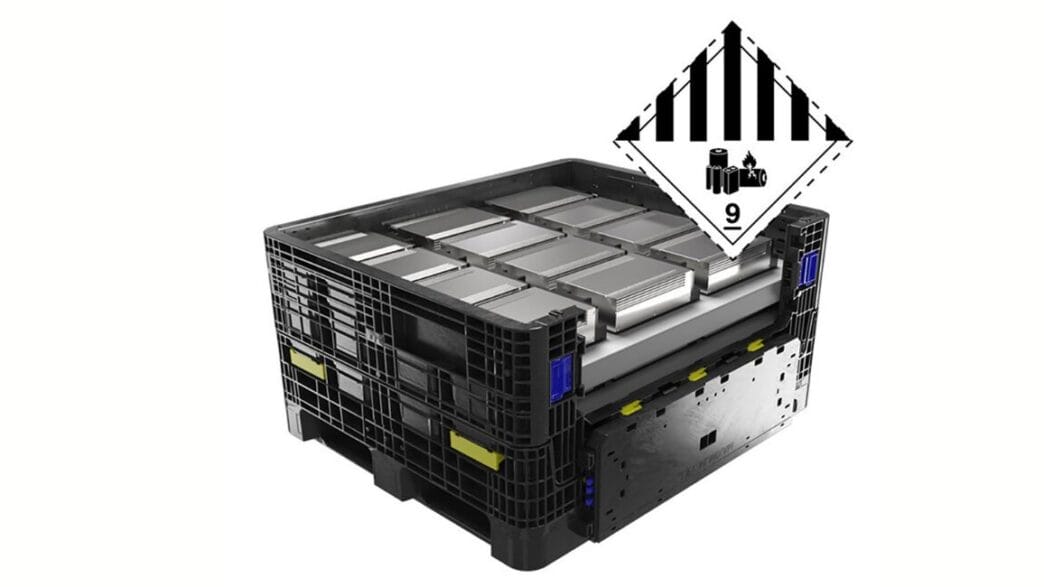
In the background, the container used meets the highest regulatory requirements for the safe transport of sensitive battery cells: it is UN 50H certified and approved for a maximum gross weight of up to 630 kilograms. A specially developed inner packaging further protects the goods by effectively absorbing shocks and reducing mechanical stress. Integrated thermal insulation also stabilises the temperature during transport.
Reusable plastic packaging
Recyclable reusable plastic transport packaging, such as Orbis Europe's IonPak, offers several specific advantages in the transport of dangerous goods: Due to their robust construction, they reliably protect sensitive batteries over many transport cycles. Individual inner packaging ensures product-specific stability and supports both manual and automated processes – the high dimensional stability and repeatability of the containers also enable seamless integration into existing automated systems.
At the same time, the higher initial costs are amortised by the long service life, often ten years or more, as well as by a buy-back option. At the end of their useful life, the load carriers are bought back, recycled and processed into new products. In view of the EU Packaging and Packaging Waste Regulation (PPWR), which increasingly focuses on reusability and recyclability, such reusable concepts also offer clear advantages.
Packaging as a strategic building block
With increasing battery volumes and more complex supply chains, transport packaging is gaining strategic importance. Reusable plastic packaging helps companies in the transport of dangerous goods to combine safety, efficiency, and sustainability. It supports automated processes, reduces lifecycle costs, and simultaneously makes a measurable contribution to resource conservation.