Bausch + Ströbel, manufacturer of filling and packaging machines for the pharmaceutical industry, has grown rapidly since it was founded 50 years ago. The new developments that the company is presenting at interpack show that the team is not resting on its laurels.
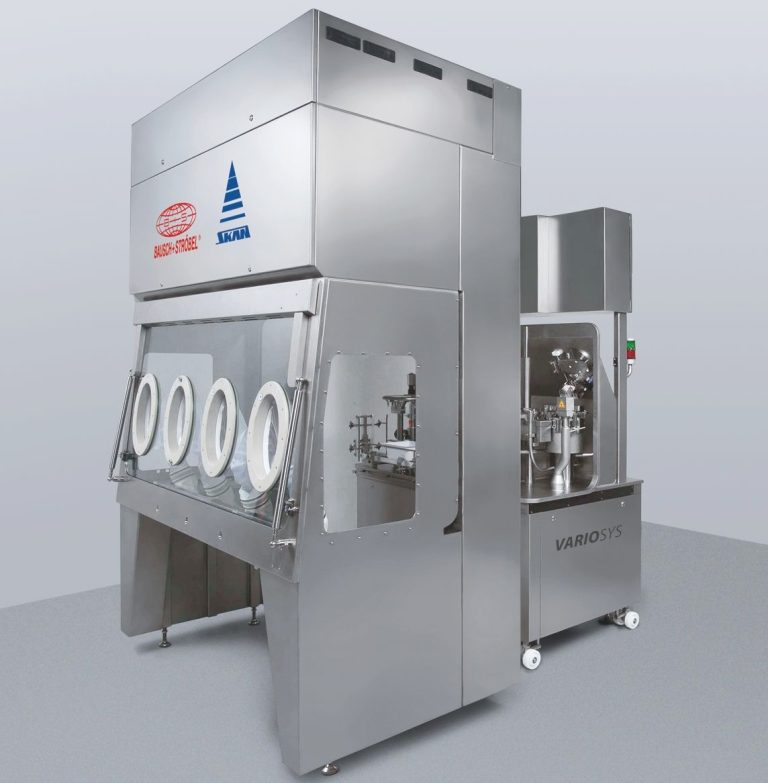
The topic Barrier technology is the common thread running through the trade fair presentation. The filling and packaging systems will be deliberately shown in combination with a wide variety of isolator solutions. These range from standardised and therefore quicker to implement and more cost-effective isolators, which the company will be presenting for the first time, to concepts specially tailored to the customer, each of which has been developed by renowned isolator manufacturers.
VarioSys production system
At the centre of this is the very flexible production system VarioSys, which B+S has developed together with the Swiss isolator specialist SKAN. It represents a novelty in the field of „quick changeover of machine modules in the production isolator“. VarioSys is a production system especially for small batchesn. A special isolator can be combined with a wide variety of machine modules. In addition, several modules can be connected in series and set up as a line with sterilisation tunnels, cleaning machines or a freeze dryer. A new machine module for processing ampoules will be presented in Düsseldorf. It processes up to 6,000 objects per hour at 100 per cent IPC. Another trade fair innovation is a special expansion option for VarioSys.

Barrier technology also plays a Virtual Reality Centre (VR), which will be used at the trade fair to demonstrate the possibilities that digital engineering now offers. A wide range of digital methods and tools will be used to validate the concept. Communication with the customer during system planning is improved and leads to significantly faster decision-making.
Compact filling and capping machine
The compact Filling and capping machine KPC is very flexible. On the one hand, special cleanroom robots take over the object transport (vial, cartridges), on the other hand, up to four workstations can be flexibly integrated into the KCP. These can also be easily exchanged later by the operating personnel. This means that the KCP can process almost any standard object without long changeover times, and a wide variety of operations such as crimping or inspection devices can be integrated into the workflow. As the same control and filling technologies are used as for high-speed systems, the processes developed here can be easily transferred to large systems. This makes the KCP particularly useful in the area of Packaging and process technology development interesting.
Bausch + Ströbel at interpack 2017: Hall 16, Stand D14