A new production facility was inaugurated at the Glandorf site of the globally operating pharmaceutical company B. Braun Avitum last autumn following an investment of around 50 million euros. An energy-saving drying process has been integrated into the processes: condensation drying with a heat pump from the Allgäu-based drying system manufacturer Harter.
The manufacturing processes for medicinal products are so complex and multi-layered that the seemingly unimportant part of drying is all too often not properly recognised. However, if drying does not work or only works inadequately, this creates a bottleneck. High-quality and reproducible drying improves the Quality of the products and optimised at the same time the Production process. A renowned pharmaceutical company has been following this path for several years by using condensation drying with a heat pump.
In the new production facility, B. Braun produces the so-called Ecoflac-plus infusion and irrigation solutions for use in dialysis. The issues of drying and cooling were immediately included in the extensive planning, namely in the form of heat pump-based condensation drying, which is now well known in the company. B. Braun has already had very good experiences with this alternative drying method at numerous other sites, which is no longer completely new but is still unknown to many operators.

Gentle and safe
The Allgäu drying system manufacturer Harter has developed the Energy-saving drying processes was developed over 25 years ago. This type of drying combines seemingly contradictory attributes with low temperatures and short drying times. With Airgenex® condensation drying and its system variants AIRGENEX®med and AIRGENEX®food, primary and secondary packaging, all products made of metal, glass and plastic, metal strips, plastic films and thin liquid films on surfaces and also organic products such as wood, food and animal feed are dried gently and therefore stress-free at low temperatures between 20 and 90 °C.
The use of extremely dry air and individually customised air routing enable Very short drying times with simultaneous high-quality drying results. At the same time, the integrated heat pump technology ensures maximum efficiency in the drying process. Drying always takes place in a closed system and is therefore completely independent of the climate. Clean room and production environments are not affected. AIRGENEX®food dryers are designed according to the Hygienic design while AIRGENEX®med drying systems also fulfil GMP and GAMP requirements. With minor adjustments, the Airgenex® condensation drying system can also be used for cooling if this is desired or required by the process.
From the experience of around a dozen Harter dryers, which are now in use in various B. Braun plants in Germany and abroad, the responsible project manager, Manfred Klass, knew about the efficiency of this drying technology. Nevertheless, drying tests at Harter were to provide information as to whether the solution was also suitable for the special requirements of the Ecoflac plus line.
Drying and cooling after sterilisation
Test series in Harter's in-house technical centre are part of the range of services offered by the drying system manufacturer and are also a sensible way of determining the parameters relevant to drying, such as temperature, time, humidity, air speed and air volume flow. They form the basis for further conceptualisation, as in the case of B. Braun Glandorf.
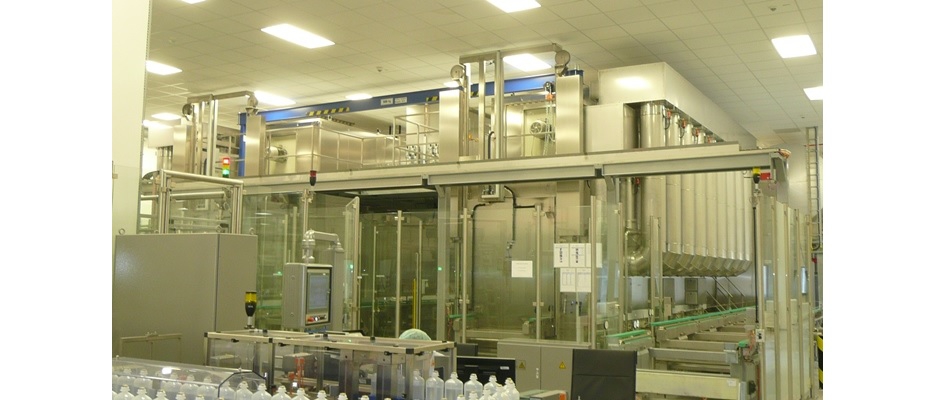
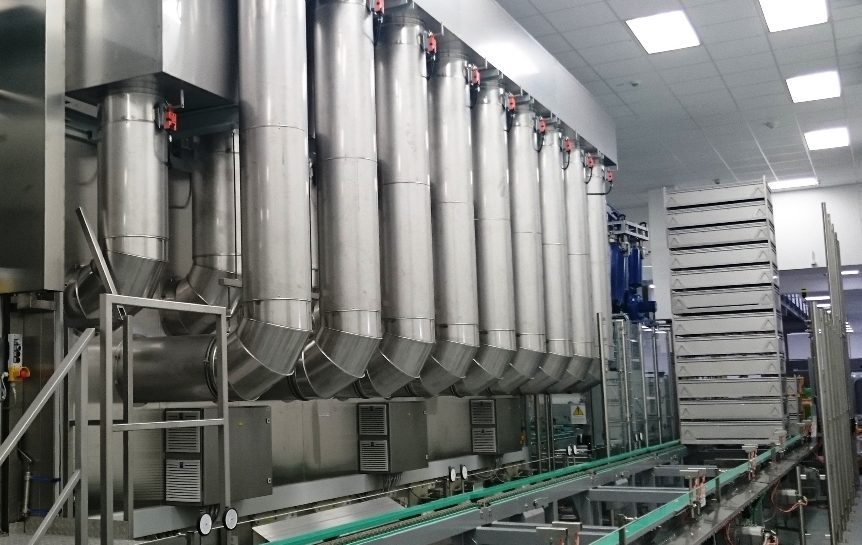
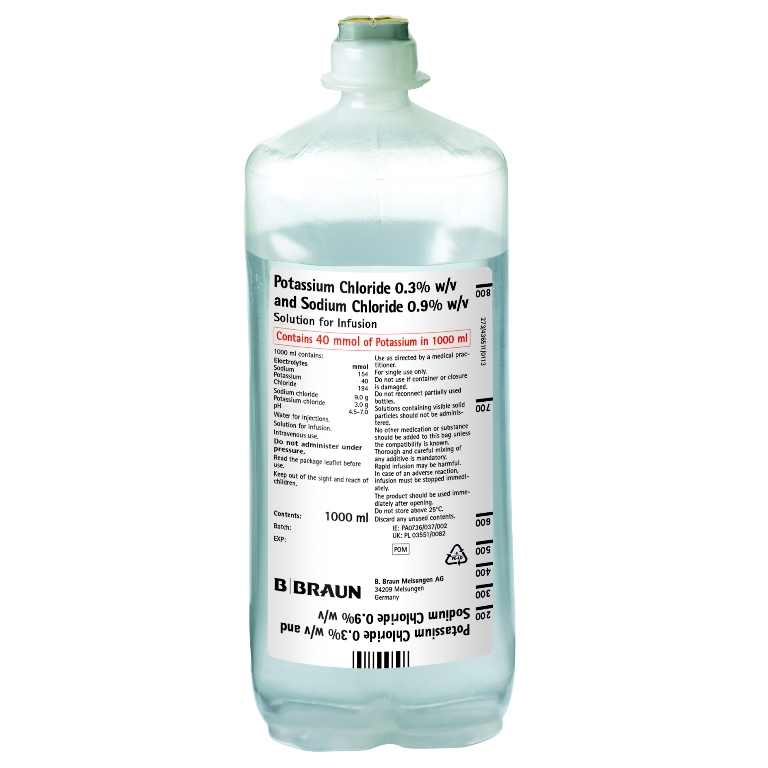
Extensive and ultimately successful tests were realised in practice using the following system technology. To match the two sterilisers, two Parallel dry-cooling tunnels each with nine rack spaces are installed. The systems are each connected to an AIRGENEX®med dehumidification module via an insulated and low-noise air duct system, which regulates the climatic conditions in the drying/cooling room. The packages to be dried, said infusion containers made of PE, are filled with a 1,000 ml solution.
After sterilisation, the plastic bottles must be dried on the outside and then the liquid must be cooled on the inside. According to B.Braun's specifications, the drying/cooling tunnel should be adapted to the cycle time of the autoclaves. The Ecoflac containers are located in loading trays, which are stacked into racks consisting of six trays each and are automatically transported into the tunnel after sterilisation. The walk-through tunnels have automatically controlled gates at the beginning and end.
)
The PE bottles are dried for between 25 and 55 minutes, depending on the recipe and load condition. The drying temperature is 60 °C. After the drying process, the tunnel is automatically switched to the cooling process. Again, depending on the recipe and load, the subsequent cooling process takes between 60 and 90 minutes. The infusion solutions have a temperature of 55 °C before drying and 42 °C after the cooling process. The drying and cooling processes are controlled by a PLC, visualised on a touch panel and are subordinate to the company's own system. In accordance with B. Braun's requirements, all products are dried and cooled completely, safely and gently in the required time, whether fully or partially loaded.
A perfect pair: dehumidification and air ducting
The answer to the extreme efficiency of condensation drying with a heat pump lies in its physically alternative approach. Extremely dry and therefore unsaturated air is passed over the items to be dried, in the case of B. Braun through the trays filled and stacked with infusion containers, and absorbs the moisture in the process. The stored moisture is then extracted from the moisture-laden air in the AIRGENEX®med dehumidification module. The moisture is condensed out and leaves the system as condensate. The cooled air is then reheated and passed on.
The Circuit is closed. The drying cycle is therefore virtually emission-free. In the cooling cycle, only the air cooler is active, which cools the air from the drying/cooling tunnel. The waste heat generated in this process is dissipated from the system via an additional condenser. The AIRGENEX®med technology, which is responsible for dehumidifying the air, is connected to the drying room or integrated into it, depending on customer requirements and available space.
Dry-cooling tunnel
At B. Braun, the dehumidification modules were placed on the tunnels as separate units. Whether Airgenex® drying is a continuous process or a batch operation is fundamentally irrelevant. The drying chamber is customised with a special air circulation system with individual air routing. Because only through the perfect interplay of Air dehumidification and Air ducting, but also the air speed and volume flow in the drying room, condensation drying is a success for the respective product.
The drying and cooling tunnels at B. Braun are each equipped with nine frequency converter-controlled air circulation fans. They ensure optimum air distribution within a rack space in the dryer and are controlled according to the load. The air circulation system and the air routing within the dryer are always customised solutions. For reasons of confidentiality, Harter does not want to explain what they look like in detail. „In the end, all that matters to the customer is that the drying and cooling process runs smoothly with both full and partial loads,“ says Jochen Schumacher.