Anyone who has ever been to the Upper Franconian town of Bamberg knows the cathedral, the residence, the old town hall, the arched bridges over the Regnitz and, of course, the delicious beer. Outstanding for its uniqueness and flavour is the „Schlenkerla Rauchbier“ from the Heller brewery. In the search for an inspection solution for empty bottles, Nagel Automationstechnik GmbH & Co. KG from Kaufungen.
Once you've tasted it, you'll never forget it. Due to its great success, „Schlenkerla Rauchbier“ is not only bottled in kegs, but also in six different varieties in 0.5-litre Euro bottles. To ensure that these are always filled perfectly clean and undamaged, master brewer Michael Hanreich had a Empty bottle inspector from Nagel Automationstechnik.
The wobbling master brewer
The first documented mention of the estate on Oberer Stephansberg, which today houses the Heller Brewery and deep below are the historic storage cellars. The history of the Dominican monastery at the beginning of the 14th century also marks the beginning of the Schlenkerla, which was still called the „Blauer Löwe“ at the time. In the middle of the 18th century, the „Blauer Löwe“ became the Hellerbräu and the family moved in with Johann Wolfgang Heller. In 1877, brewer Andreas Graser was the man who, because of his lurching gait gave the beer its name. In 1943, Elisabeth Trum and her husband took over the business, and in 1967 they passed it on to their son German Trum, whose son Matthias has been running the brewery since 2003. This makes him the 15th master brewer of „Zum Heller“ and the sixth generation of the Graser/Trum family.

The brewery's speciality for centuries has been the Smoked beer. Its secret is not only that the brewery is one of the last to still produce its own malt from barley, but also its special process. Schlenkerla has maintained the smoked malt tradition throughout the centuries. The „Aecht Schlenkerla“ is one of the last traditionally produced smoked beers, which is available in the varieties Märzen, Lager, wheat beer, Ur-Bock, Doppelbock and now also in bottles as „Kräusen“.
Search for the right inspection
A large proportion of the smoked beer is filled into barrels, and in the brewery pub it is even still served from oak barrels. However, the proportion of bottled beer is increasing, not least because the beer is now exported to over 40 countries. It is filled into 0.5-litre Euro bottles and packed either in 20 x 0.5-litre crates or in outer packaging for further transport. The cramped, small bottling plant at the foot of the Stephansberg has a capacity of 5,000 bottles per hour and runs three to four days a week.
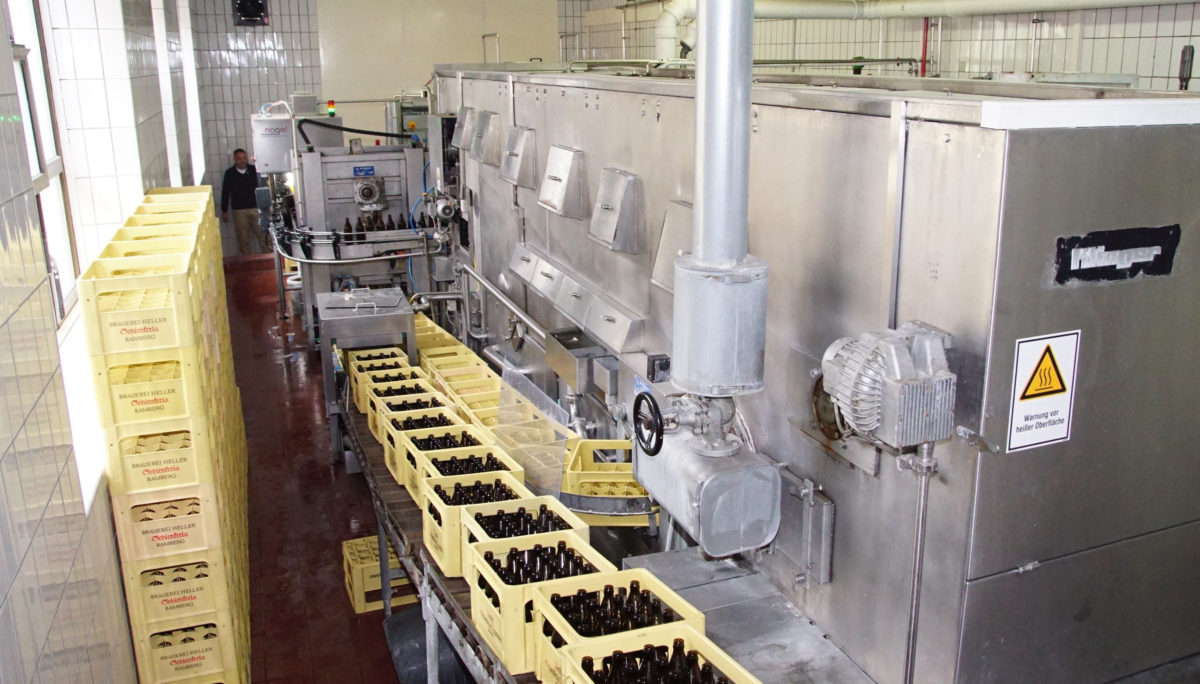
Until recently, not only palletising and depalletising as well as the detection and removal of foreign objects in the crates were purely manual work, but the quality of the bottles after the washing machine was also carried out by an employee in front of a screen.
„We have never had any problems with quality or complaints. But in the age of Product liability In the event of a complaint, it is necessary to be able to easily document that we value the highest possible quality. That's why we spent a long time looking for an inspection machine that would fit into our plant in terms of performance, size and price. Above all, we couldn't afford to shut down the line for a fortnight due to our very limited storage capacity,“ explains the master brewer Michael Hanreich, who has been in charge at Schlenkerla for three and a half years.
Inspection technology from Nagel Automationstechnik emerged as the optimum solution.
Extremely compact all-round inspection
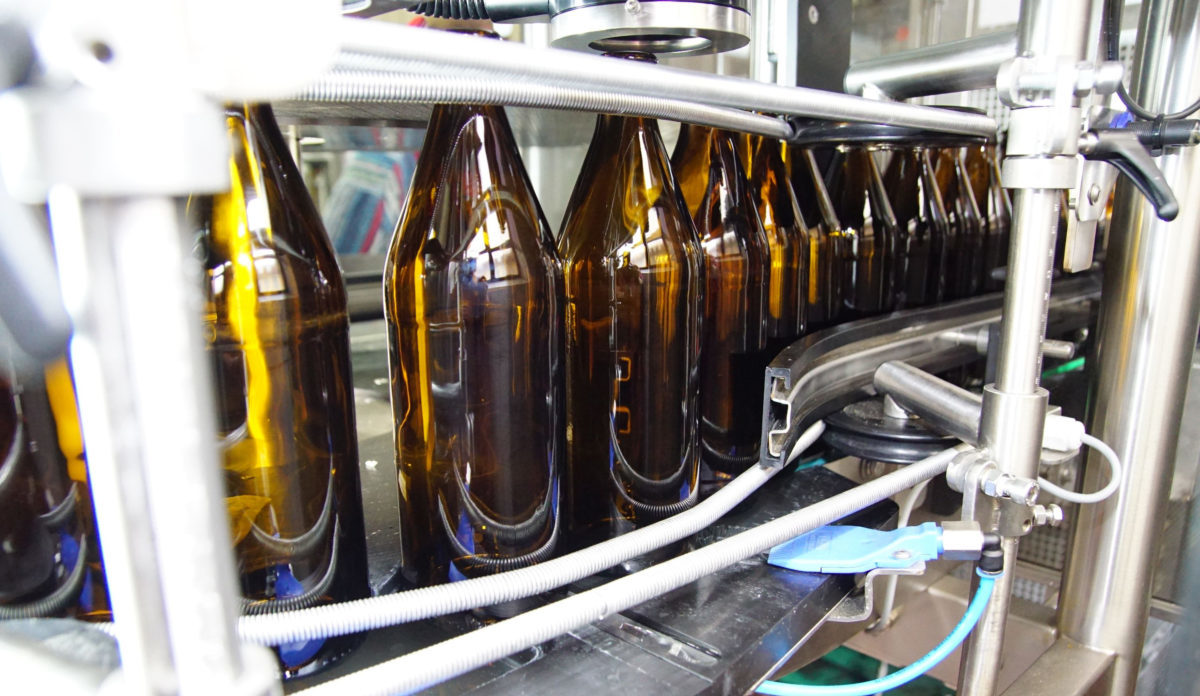
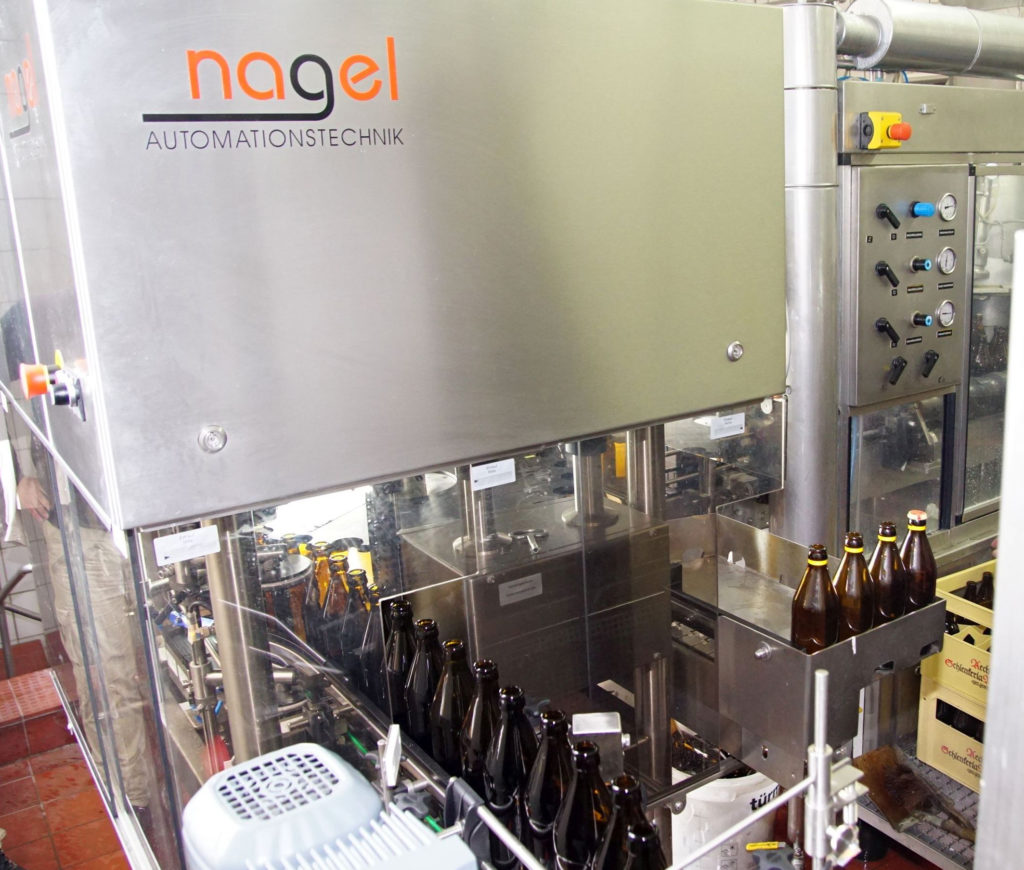
For the Schlenkerla in Bamberg, the company delivered a Full inspection machine. Thanks to its optimised design and several new developments, for example in the area of sorting, it fits perfectly into the narrow gap between the bottle washer, unpacker and filler. Nagel has designed the machine in such a way that the bottles are safely discharged at the starwheel. Areas for possible dirt deposits have been eliminated as far as possible. The bottles enter the inspection machine shortly after the washing machine and are inspected there by a high-quality control system with Ethernet CCD cameras and wear-free LED technology for the lighting.
Side walls and floor
First of all, the sensitive floor area is checked for damage and contamination with the utmost precision and any Foreign body at the bottom of the bottle recognised. Known typical problems such as yeast residues, cigarette foil or syringes are reliably detected. The next step is the Checking the side walls for damage and contamination. This check is carried out by fully rotating the bottle, whereby up to ten images are created and analysed: Even drinking straws, masonry dirt, label residue or mould are reliably detected.
Flawless finish and no residual liquids
In terms of product safety, intact neck finishes are very important. Additional high-performance cameras detect defective or broken bottle neck finishes. This eliminates the risk of injury as well as leaking caps and product spoilage.
Nagel has also found special solutions for liquid contaminants: The system recognises even small quantities of residual liquid or lye by means of the High-frequency transmitter-receiver measuring principle. Residual lye is detected 100 percent from a quantity of one millilitre, residual water is reliably detected from a quantity of ten millilitres.
Rejection and logging
The fully inspected bottles are transferred from the star wheel back onto a conveyor belt in the direction of the filler. Any faults, damage or contamination that are detected lead to a reliable Sorting via flap technology. The bottles are guided safely and vertically to the outlet via two flaps in the star.
All production data, test bottle logs and machine statuses are available in clearly organised logs and can be printed out automatically or on demand. The logs are stored for years in accordance with legal requirements and can therefore be retrieved in the event of an emergency. Product liability can be used.
Further increase in quality
The Nagel specialists were only able to bring the compact machine into the system via the window to the street. The complete installation and commissioning then took place within two days.
[infotext icon]„We're still working out how sharp we can make the Control because every tiny scratch is recognised, which of course is not a real defect in the side wall. But this inspection fits perfectly into our small plant and our budget,“ summarises master brewer Hanreich with satisfaction. „We were able to optimise our High quality further increase.“
Joachim Nagel launched his empty bottle inspection machines in July 1995. Since then, numerous well-known beverage and food companies have opted for the compact solution, which enables completely new installation situations. All inspections take place within a 500-millimetre radius, which means that very small footprint a full inspection can be installed[/infotext].
Nagel Automationstechnik at the BrauBeviale 2018: Hall 7, Stand 359