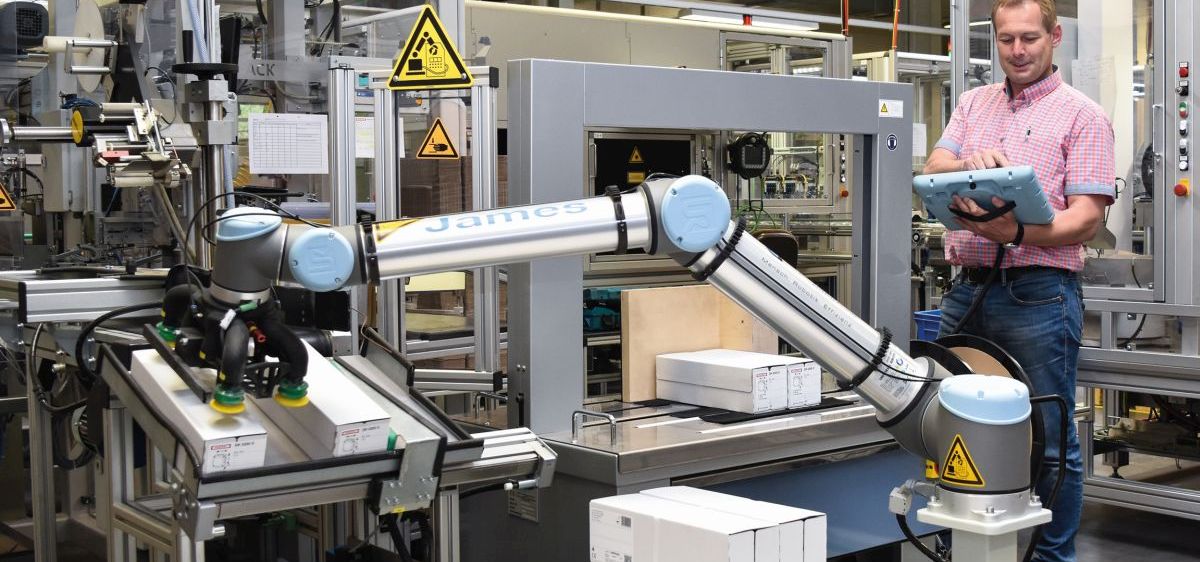
Gustav Hensel GmbH from Lennestadt has optimised its production processes with a collaborative robot. A robotic arm from Universal Robots supports the employees in palletising pre-packed cable junction boxes. Now 2.5 tonnes of packages no longer have to be moved manually per shift.
The Gustav Hensel GmbH & Co. KG in Lennestadt, Sauerland, manufactures according to the „lean principle“. Around 550 employees develop and produce electrical installation and distribution systems. Automation helps to operate processes efficiently along the entire value chain and secure production at the local site.
In its search for further optimisation opportunities, the medium-sized company identified the Palletising of pre-packaged cable junction boxes as a potential saving. Previously, this activity accounted for a large number of man-hours. Christoph Kaiser, Head of Plastics Production at Hensel, emphasises: „Our aim was not to replace employees, but to create more capacity for higher-value activities. In terms of lean thinking, manual packing and bundling of cartons was absolutely not value-adding.“

In order to automate the palletising task, Hensel decided to use a collaborating robot from Universal Robots (UR). A visit to a trade fair revealed that the Danish company's offer best met the requirements. The robot was not to be enclosed. Instead, what was required was permanent, direct access. It also needed to be able to handle a fairly high payload and have a long reach.
Palletising robot should manage without an enclosure
„If the robot can Packaging units The fact that the machine has to be placed all the way down on a pallet means that its extensive working radius is extremely important,“ explains Christoph Kaiser. The requirements were ultimately met by the largest Robot model UR10 with a load capacity of ten kilograms and a reach of 1.3 metres.
The „First Cobot“ project was finally realised in spring 2017 with the help of the UR partner Dahl Automation GmbH. The Meinerzhagen-based company also supported Hensel with the risk assessment for the Robot arm. This was necessary so that the system could work in close proximity to its human colleagues. The basis for this are the patented safety systems from UR.
Overall, the integration of the UR10 at Hensel only took a few days. André Gödde, Sales Manager at Dahl Automation, reveals: „Before we put a robot arm from UR into operation at our customers, we put the application through its paces in our own factory. This allows us to react quickly if, for example, motion sequences need to be optimised.“ On average, installation at the customer's premises is completed in one to two days.
Collaborating robot manages 1,200 packaging units per shift
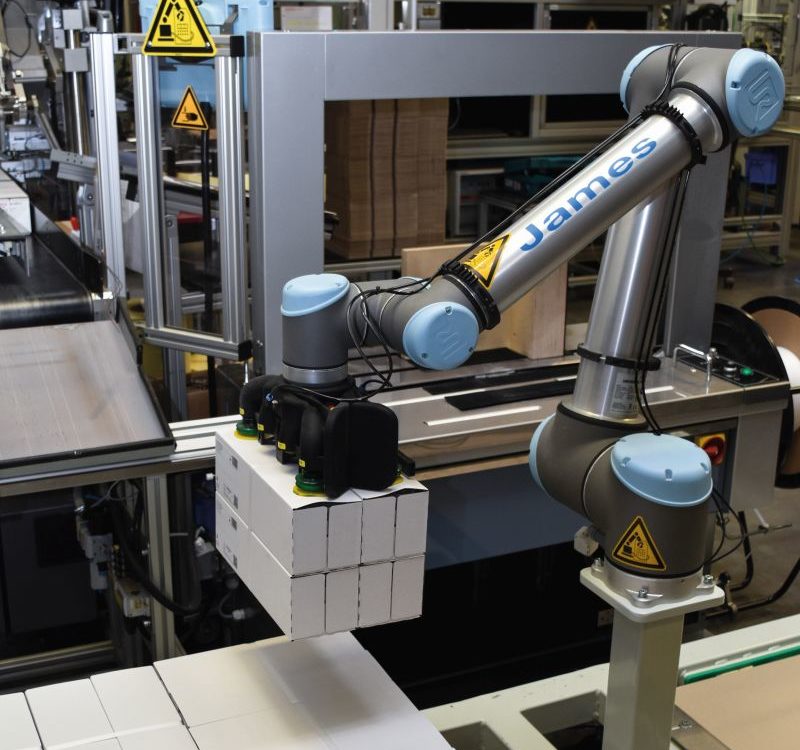
The UR robot now palletises 1,200 packaging units per shift in two-shift operation. The UR10 is the final component in a complex, fully automated system made up of Assembly and packaging machines for the production of cable junction boxes. The system provides the robot arm with two pre-packed products at a time. In a first step, the UR10 picks up the two boxes with a suction gripper specially manufactured by Dahl Automation and places them in a Strapping machine. After it has placed another pair of parcels there for bundling into a four-unit, the machine straps them. The robot arm then stacks the cardboard bundles on a Euro pallet. „The UR10 lifts just under ten kilograms during this last process, which means we fully utilise its load capacity,“ says Christoph Kaiser.
To further increase efficiency, Hensel provides the UR robot with two Euro pallets. Once one of them is full, the UR10 automatically continues stacking at the other pallet location. „The employee then only has to move the full Euro pallet out and prepare the next one for the UR robot,“ says Kaiser, pointing out the optimal utilisation of the application.
Depending on requirements, the robot arm can various carton sizes process. It can be reprogrammed in less than three minutes with just a few clicks.
„Our daily work is much easier physically, but has also become more demanding thanks to modern production methods such as automation.“
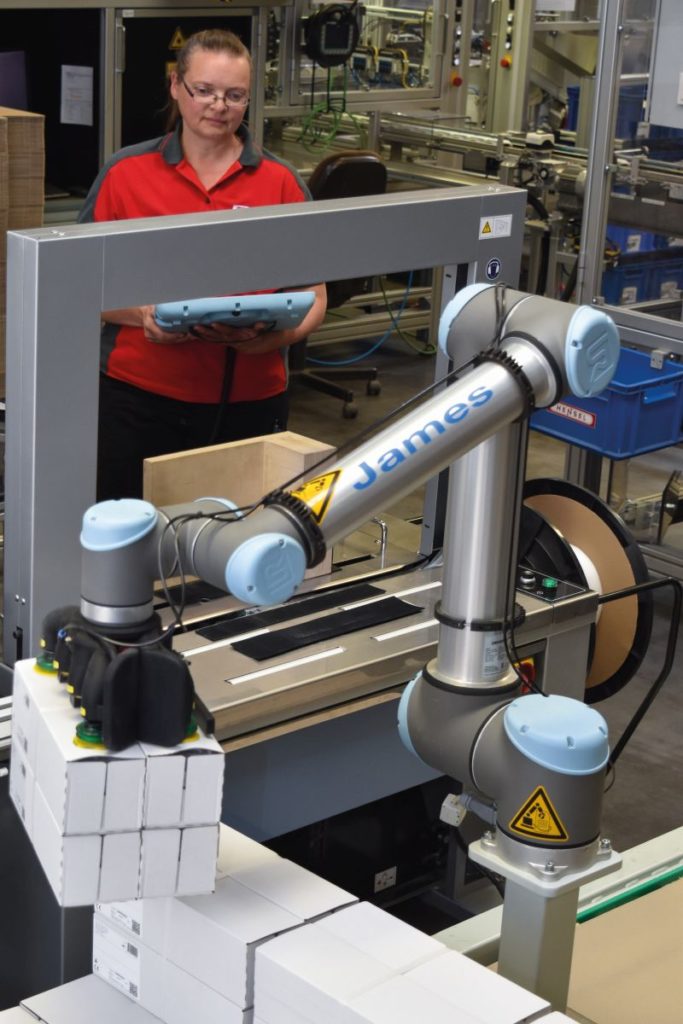
Lydia Reichling works constantly with the cobot „James“ as a shift worker.
Palletising robot saves monotonous and stressful stacking
The relief for employees at Hensel is clear. The UR10 takes over the monotonous and stressful task of stacking boxes on the Pallets - and was therefore christened „James“ by his human colleagues. „Around 2.5 tonnes of parcels had to be moved per shift,“ recalls Christoph Kaiser.
To operate the palletising robot two production employees at Hensel were initially trained online at the „Universal Robots Academy“. Dahl Automation then taught the users more in-depth robotics expertise in a further one-day training course.
Overall, the UR10 is characterised by its ease of operation. The two shift workers who interact with the robot during day-to-day production can rectify occasional interruptions in robot operation themselves.
For example, if someone accidentally bumps into the robot arm and the integrated function for Safety stop of the UR, colleagues can restart it with just two clicks on the teach panel. The UR10 is designed in such a way that it continues to run its normal cycle smoothly afterwards.
Second cobot already in service
The project of the first Cobots was successful, everyone at Hensel agrees. The „help“ provided by the automation system has been well received by the employees. While the UR10 is constantly palletising, they can now focus even more intensively on optimising the assembly systems themselves. This increases overall productivity in the manufacture of the cable junction boxes.
The positive experience with the UR10 has encouraged those responsible to deploy another cobot. Since autumn 2018, a new robot colleague has been supporting the workforce at Hensel's Würdinghausen branch not only in palletising, but also in the quality inspection of membranes