Paper bags for food - quality assurance at the highest level
When packaging powdered foodstuffs such as flour, milk powder or herbs and spices, the German paper sack industry contributes to optimum product protection with many different factors.
25. June 2018
The paper sack manufacturers guarantee optimum protection of the food to be packaged with extensive quality assurance measures.
From A for flavour protection to L for shelf life and Z for Z-fold: When packaging powdered foods such as flour, milk powder or herbs and spices, the German paper sack industry contributes to optimum product protection with many different factors. It also takes extensive measures to ensure the flawless quality of the packaged products.
Quality assurance begins with the selection and testing of the materials used, the design elements and the entire sack construction and ends with the careful monitoring of paper sack production. The following applies: The longer the paper fibres are, the more tear-resistant the paper is. Fresh, unground softwood fibres are therefore used for kraft paper. They are processed into a stable fibre network during paper production, which further increases the tear resistance.
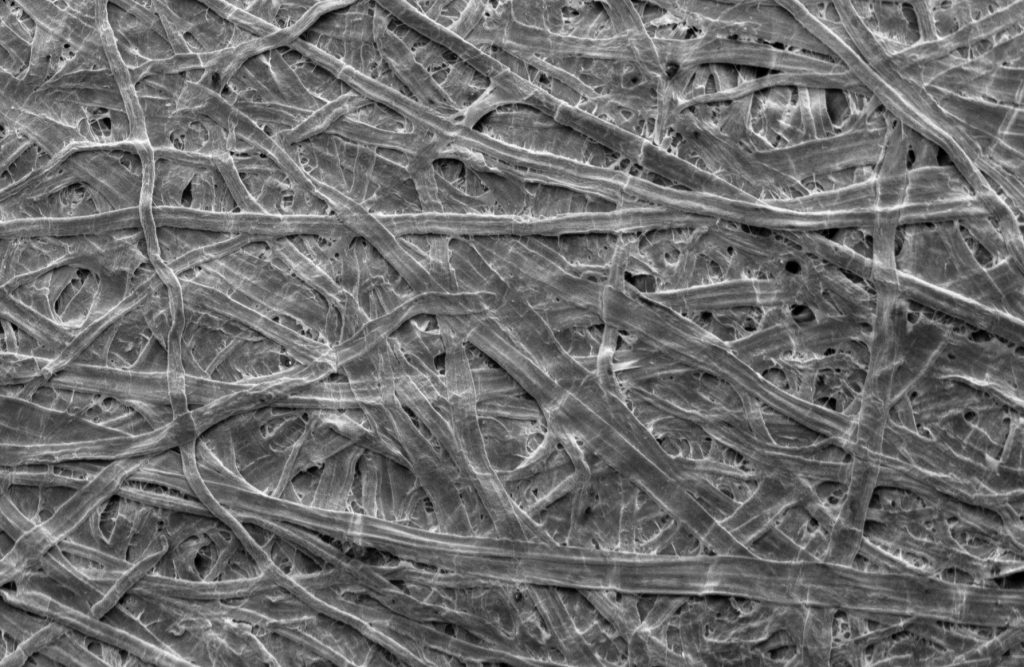
During paper production, the softwood fibres are processed into a stable fibre network (enlarged 50 times), which further increases the tear resistance.
Test procedure for material testing
To test the resilience of the paper, a so-called Tensile test on test strips of the individual paper layers. The energy that a strip of paper can absorb before it tears is determined. This energy is called Tensile Energy Absorption, short TEA. For an average two-ply 25-kilogram bag, a TEA value of between 320 and 430 joules is assumed. This is roughly equivalent to the energy required to lift 40 kilograms of log one metre.
How tear-resistant a paper sack should be depends on not only from the filling product . The decisive factor is also the transport route, the country and the intended use. For foodstuffs such as cocoa products, food additives, milk powder or ready mixes, which are expensive due to raw material prices and production costs and are often exported worldwide, very tear-resistant paper sacks are used, which typically have a TEA of 450 joules or more. Protective barriers against moisture and other external influences are also used. „This is necessary as there is a high level of humidity in many importing countries and the paper sacks are traded loose in containers and sometimes transported onwards under very harsh conditions,“ emphasises GemPSI member Robert Kock. The Gemeinschaft Papiersackindustrie e. V. (GemPSI) is the German trade association of paper sack manufacturers.
Robert Kock
„Tear resistance is the basic prerequisite for ensuring that the paper sack can withstand the many different loads without damage, for example during filling, transport or handling. The Selection of suitable material - The strength of the paper sack - i.e. the strength of the kraft sack paper - is an important criterion for quality assurance, as the tear resistance of the paper sack depends largely on it,“ explains GemPSI member Robert Kock.
Ensure tear resistance of the construction
In addition to the selection and testing of the appropriate paper, the selection and testing of the right packaging material must also be taken into account when packaging foodstuffs. adequate barrier layer must be taken into account. Various plastic films can be used in the paper bag as a coating, web film or inliner (inner bag) to protect the product from the ingress of aromas, oxygen, grease, acids, water vapour and moisture. Unperforated films are used to prevent product transfer and contamination. Special Venting systems ensure that the bags can be filled at high speed.
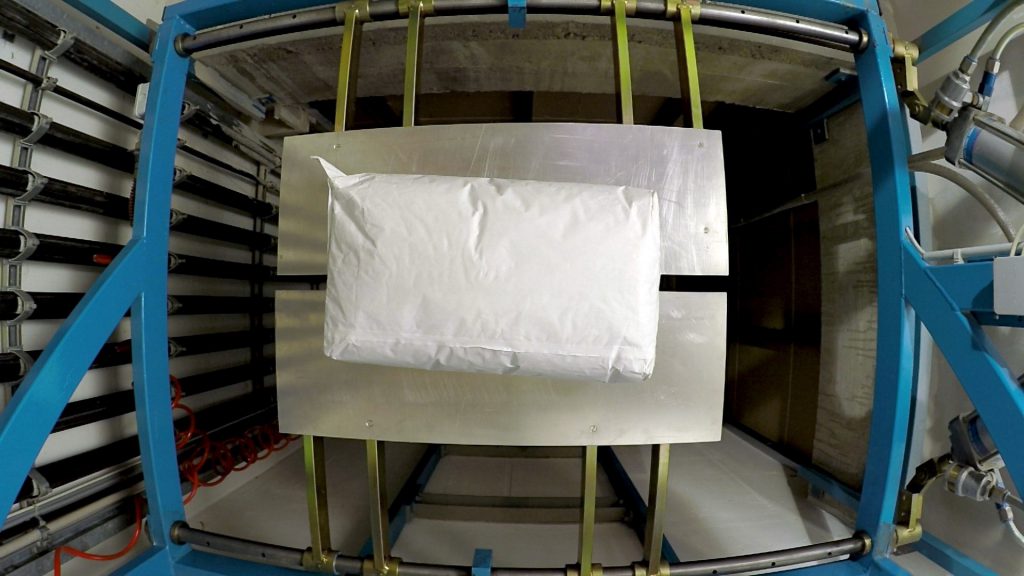
Another plus point for quality assurance: the storage time of packaged food can be determined using a Protective barrier increase. Analogue to the tensile test, a so-called Dart test by dropping a rounded metal body onto a film surface to ensure its tear resistance. The tear resistance of the entire sack construction is also put to the test by means of a drop test. To do this, a filled paper sack is dropped from a drop table tower onto critical surfaces, for example onto the side or even the floor adhesions. The sacks must survive such drops without any defects.
In the drop test, the tear resistance of the entire bag construction is put to the test.
Design elements for tightness and quality
With the help of constructive elements special valves, adhesives or inliners can be used to further increase tear resistance, dust resistance and product protection. Thanks to a Thermal sealing a valve bag can be securely sealed. The valve is provided with a sealable coating and tightly sealed immediately after the fully automatic filling process. In addition, the air ducts can be sealed with a special coating at the points in the valve/stand area where one or more layers are folded. Adhesive technology be closed. This prevents the powdery filling product from escaping from the valve or the base, and prevents foreign bodies and water vapour from entering.
An inliner with a z-shaped fold is inserted into the body of the bag to ensure a particularly high level of product protection for the open cross bottom bag. Both the base and the upper edge are sealed after filling. This creates an absolutely leak-proof film inner bag that can be removed in its entirety from the sturdy paper bag transport packaging and further processed in clean rooms. All these designs prevent contamination by foreign substances and ensure increased cleanliness.
Thanks to special welding technology, food can be packaged in paper valve bags in a completely sealed and dust-free manner.
Close-meshed quality assurance during production
The production of paper sacks for food is also crucial for ensuring product safety. The German paper sack industry ensures this with a comprehensive Hygiene management along the entire supply chain to protect the food to be packaged. In addition to complying with national and EU-wide regulations and laws, the paper sack manufacturers carry out migration tests, supplier audits and safety precautions based on a HACCP (Hazard Analysis and Critical Control Points) analysis.
When raw materials are delivered, for example, checks are carried out to ensure that the goods are in hygienic packaging was delivered. Strict hygiene regulations apply in the production area (from hand sanitising to wearing hygienic work clothing). Regular cleaning, pest control and quality checks ensure that no foreign bodies, bacteria or harmful germs can enter the paper sack during production. For example, the adhesives used are analysed for bacteria and the paper sacks are checked with special detectors to identify foreign bodies such as metal.
[infotext icon]Tear resistance of paper bags
In a four-part video series, GemPSI explains the background to the tear resistance of industrial paper sacks and demonstrates how this can be measured and ensured using test methods. The series includes an explanatory video, an expert interview, a practical test and a drop test and is available on GemPSI's YouTube channel or in the media centre at http://www.papiersack.de.[/infotext]
Flawless appearance thanks to high print quality
In addition to product protection and hygiene, paper sacks also fulfil the highest demands in terms of Product management and Marketing. Many colours can be printed using a combined line and halftone printing process. The use of a common Colour template standards guarantees customers that they can achieve uniform colour shades at any time using colour numbers. For quality control purposes, the colours are sampled under a standardised daylight lamp and adjusted if necessary. In addition, an inspection device ensures accurate printing. Colour tones can be checked using live colourimetric controls. Consistent quality during application is also guaranteed, as lightfastness and abrasion resistance are guaranteed during printing.