With the European Packaging and Packaging Waste Regulation (PPWR) coming into force, a new era is beginning for the packaging industry. At Future Resources 2026 in Cologne, Franziska Safak, Secretary General of the Central Agency Packaging Register (ZSVR), made it clear that companies now face a reorganisation of their processes – not only with packaging itself, but particularly in their handling of data, information, and supply chains.
For Franziska Safak, the most important message is clear. „We can finally say with certainty: the PPWR and the VerpackDG will come on 12 August.“ This was preceded by intensive political work in recent months. „We really have reason to celebrate, because Germany is the only country that has established national law based on the PPWR by 12 August, its launch date.“
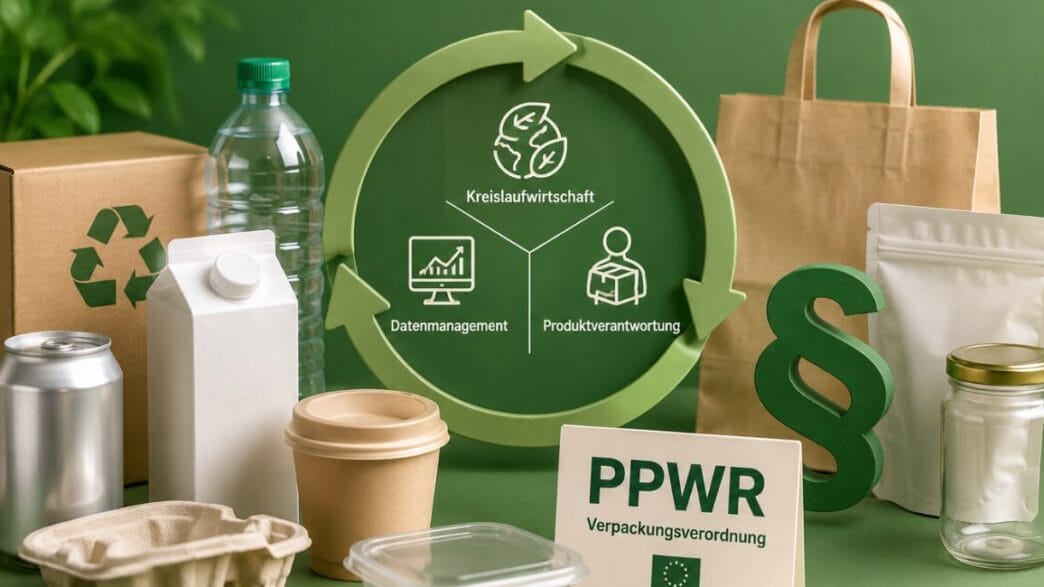
In the ZSVR's view, the new legal situation will change far more than individual technical requirements. It leads to a new logic of product responsibility, in which packaging can no longer be considered in isolation but must be understood as part of complex material, data, and logistics systems.

The Declaration of Conformity becomes the key instrument
The PPWR will require significantly more extensive datasets in the future than before. Companies will have to record, document, and make information available along the supply chain in a standardised way. „The declaration of conformity will clearly be the central instrument for proving compliant packaging in the future.“
This becomes particularly clear in the development of new packaging. Previously, decisions were often driven by marketing requirements, product protection, and cost. However, under the PPWR regulations, other criteria must be brought more to the fore. „In the future, consideration must be given from the outset of packaging design to how packaging behaves – throughout its entire life cycle,“ says Safak. This means packaging is regarded as a circular product from the start. Companies must consider how materials can be used multiple times, reused, or recycled to a high standard. And topics such as reusability, reuse, and lifecycle extension will become central to strategic decisions.
Recyclability is moving into focus
A key point of the PPWR concerns the recyclability of packaging. Franziska Safak: „In the future, responsibility along the supply chain will be shifted forward to the producer. They will be responsible for ensuring that recycling can take place at the end of the day, that the dual systems can meet quotas, and that sorting facilities are able to separate the correct materials.“ The consequences are significant: material selection, colours, composite structures, or labels could in future determine whether packaging is considered compliant or not. Companies must therefore integrate ecological criteria into their development processes much earlier than before.
VerpackDG comes just in time for PPWR: ZSVR Secretary-General Franziska Safak
Data is becoming the crucial resource
The implementation of the PPWR will not be possible without functioning information flows. The ZSVR therefore sees data as a central success factor. „Even in the first phase, large amounts of information will be generated about materials, packaging categories, and technical evidence. Suppliers, logistics service providers, and manufacturers must collect and exchange this data.“ The challenge lies not only in the quantity of data but also in its quality. Three conditions are crucial for the implementation of the declaration of conformity: „The data must be complete, correct, and, of course, unambiguous.“
Brand owners are being held more responsible.
One point of discussion concerns the role of brand owners. Here, the PPWR has deliberately stipulated that brand owners can assume producer responsibilities themselves under certain conditions. The reasoning is obvious: brand companies.
This becomes particularly relevant with a view to the planned eco-modulation. Packaging that is more difficult to recycle will be treated differently from an economic perspective in the future compared to easily recyclable solutions. This creates additional financial incentives for sustainable packaging design.
At the same time, new information offerings for consumers are emerging. Details on recycled content or the origin of materials are increasingly becoming purchasing criteria. Safak expects that this information will have a significantly stronger influence on purchasing decisions in the future.
Supply chains need to work together more closely
The new requirements clearly show that packaging compliance can no longer be organised in isolation within individual companies in future. Instead, a new form of collaboration is emerging along the entire supply chain. Companies would have to enter into new partnerships and make agreements on data exchange. This is the only way to ensure that all necessary information is available.
At the same time, new conflicting objectives are emerging. Much of the information concerns sensitive recipes, material compositions or economically relevant production data. Companies therefore face the task of reconciling transparency and data protection.
Franziska Safak attaches particular importance to the comprehensibility of regulatory requirements. She describes the collaboration between ZSVR and the Forum Rezyklat as an important step in translating complex technical specifications into practical recommendations for action.
Compliance becomes a competitive advantage
Despite all the challenges, Franziska Safak explicitly sees the new requirements as an opportunity. The PPWR forces companies to link previously separate areas more closely together. The actual transformation therefore concerns not so much the packaging itself as the underlying information flows. „The bigger task will be to reorganise the information flows that will be necessary in the future along the entire value chain.“
Those who establish these processes early can not only minimise regulatory risks but also achieve competitive advantages. This is because transparent supply chains, better data quality and recyclable packaging solutions are increasingly becoming differentiating factors in the market.