What happens if individual systems fail in the increasingly connected world of the future? Omron is addressing this question and presenting its zero-defect solutions at productronica 2019 in Munich.
Imagine a city centre of a modern metropolis in the year 2030: electrically powered vehicles drive unmanned and almost silently through the streets, automatically detecting traffic lights and road signs and making decisions based on artificial intelligence. They avoid people who unexpectedly cross their path and recognise dangerous situations before they arise. This, or something similar, is what the traffic situation could look like in 2030. But what happens if the associated electrical systems fail?
Technologies are more advanced than laws
Many parts of the scenario described are already technically feasible today. Today, technologies are more advanced than draft legislation, insurance regulations and social acceptance. The question of residual risk or what happens in the event of system failures is often unresolved, which prevents earlier deployment.

[infotext icon] Zero defect is a process in which all electronic assemblies and the associated components are individually and comprehensively tested after manufacture. At present, many manufacturers consider 100 per cent testing of these systems to be too time-consuming. Instead, manual random samples are taken, which not surprisingly leads to some faulty components not being recognised. [/infotext]„There is no question that unmanned vehicles, e-mobility and artificial intelligence will become the technical norm. It is therefore all the more important to rule out residual risks in order to avoid potential damage. This is why Omron has developed the zero-defect concept, which addresses precisely this issue“
Kevin Youngs, Sales Manager Europe at Omron Europe B.V., Automated Inspection Systems Division Europe.
To ensure a complete inspection, the systems must work quickly and reliably. The cycle times of the production processes must not be negatively affected by the inspection. Omron has therefore launched new systems in the field of AOI (Automated Optical Inspection), SPI (Solder Paste Inspection) and AXI (Automated X-Ray Inspection) systems in recent years that fulfil these requirements. For example, the new 3D SPI VP-9000 was introduced at the beginning of the year, which offers a switching function for several optical resolutions. This enables both 2-dimensional and 3-dimensional inspection.
Recognise differences as well as the human eye
This was followed in the spring by the VT-M121 Automatic Visual Inspection (AVI) system, the first system developed for industry-wide 2D dimensional control and visual inspection to detect scratches and cracks on products. Thanks to the built-in FH-Vision system, the VT-M121 inspection system can also detect defects with slight colour differences. This was previously only possible with the human eye.
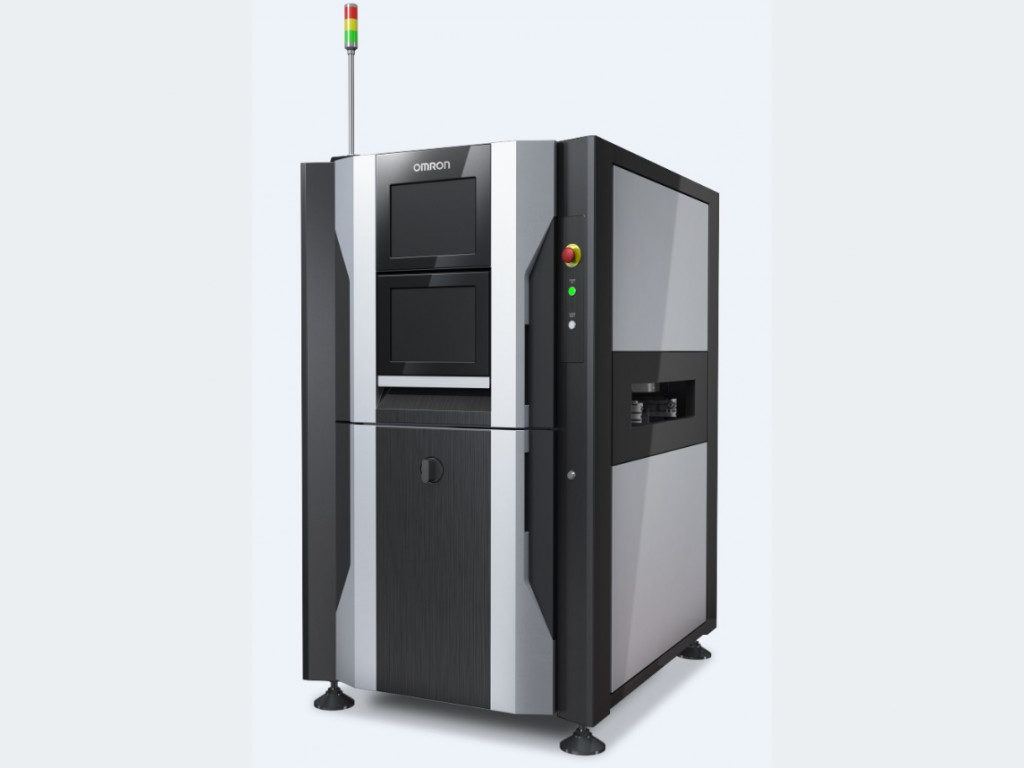
This is achieved by an image processing system with different lighting patterns, which allows the colours and lighting angles to be flexibly adjusted. Other systems minimise camera vibrations and thus enable high-speed and high-precision inspections. This shortens inspection times and improves inspection performance with a repeat accuracy of 10 µm (*2).
[infotext icon] Omron will be presenting Zero-Defect with all its components at productronica 2019 in Munich, in Hall A2, Stand 331.„Our inspection systems and the associated software landscape can replace previous processes that were based on spot checks. With fully automated inspection, a zero-defect result can be achieved, which fulfils the automotive industry's demand for high quality and reliability in particular. This is particularly necessary when it comes to e-mobility and unmanned systems“
Kevin Youngs, Sales Manager Europe at Omron Europe B.V., Automated Inspection Systems Division Europe
Source: OMRON