Artificial intelligence (AI) and machine learning are increasingly becoming the focus of SMEs and will profoundly change existing business models. This is the conclusion of Deutsche Telekom's fourth benchmark study „Digitalisation Index for SMEs“.
More sales, better processes, higher quality
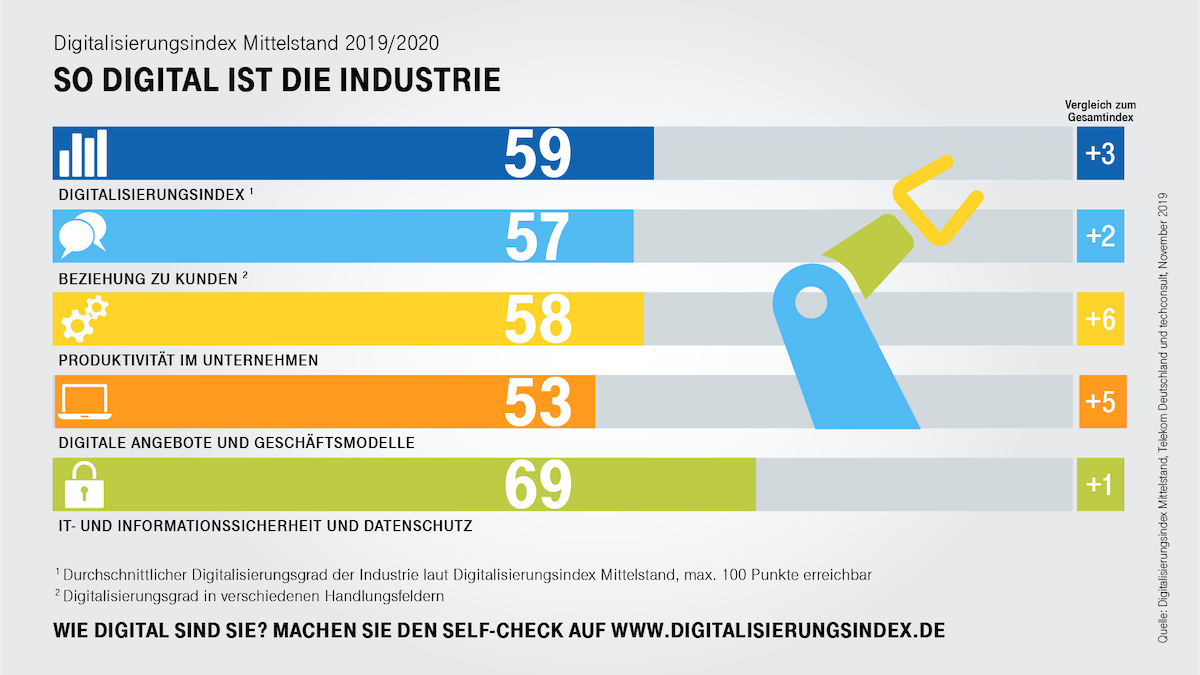
The results of the study show: Small and medium-sized industry is 59 index points, one of the most digitalised sectors in comparison in Germany. For example, 43 per cent of industrial companies state that they have improved their operating result through digitalisation. More than half (54 percent) were able to optimise their processes and 45 per cent increase service and product quality.
„It also shows that the degree of digitalisation and satisfaction are closely linked. The more digitalised, the better the development of turnover, quality and customer proximity.“
Hagen Rickmann, Managing Director Business Customers at Telekom Deutschland
Predictive maintenance very relevant
Especially the Internet of Things (IoT), predictive maintenance and the intelligent analysis of business data (business analytics) increases the productivity of companies along the entire value chain.

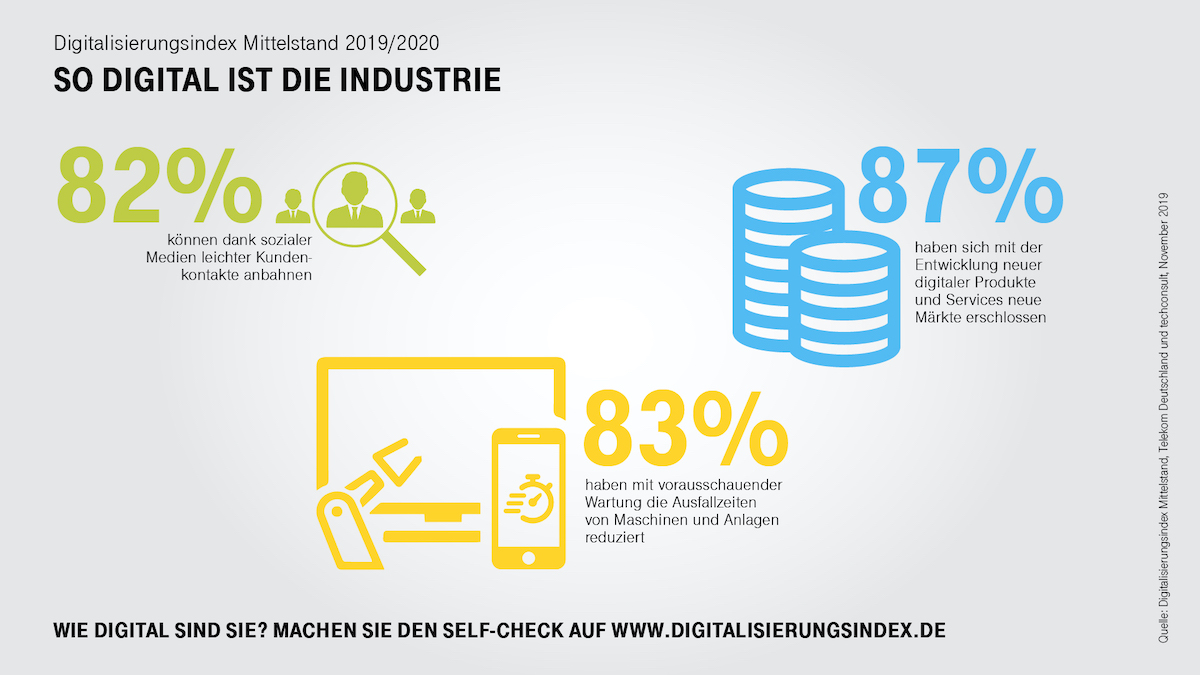
For more than half (51 per cent) of those surveyed, the option of predictive maintenance is highly relevant, and more than a third (35 per cent) already use such solutions in daily practice.
Successful 40 per cent of industrial companies consider predictive analytics to be a decisive factor. 29 per cent have implemented corresponding solutions.
Cloud opens the door for IoT and blockchain
After initial scepticism, cloud computing has now also become an integral part of IT in the SME sector. 87 per cent of companies state that cloud computing has become an integral part of IT. Cloud platforms have a positive impact on the availability and performance of their IT services have an impact. For 83 per cent, the cloud simplifies access to technologies such as IoT, machine learning or blockchain.
Companies are also increasingly digitising their own products and services. A good quarter (26 per cent) are enhancing their products with networked, intelligent functions. 90 per cent of industrial companies have thus increased customer satisfaction.
High investment costs and lack of qualifications
The investment costs of such digitalisation projects are 42 per cent of the companies surveyed. And almost a third consider technical integration (30 per cent) and IT security (31 per cent) to be major challenges in their digital transformation.
The vast majority of the companies surveyed report an urgent need for action when it comes to digitalisation. Qualification of your employees goes. Only 29 per cent (previous year: 32 per cent) of industrial companies believe that their employees are optimally qualified for the digital economy.
Free self-check
In summer 2019, analysts from techconsult surveyed almost 2,100 small and medium-sized companies from various sectors about the current status of their digital transformation for the fourth time. The current overall study report and individual industry reports are now available on the website http://www.digitalisierungsindex.de available for download.
[infotext icon]Companies that are interested in their own digital status quo can find it at http://www./benchmark.digitalisierungsindex.de in a free online self-check in just a few minutes[/infotext].Source: Deutsche Telekom AG