From 2020 to 2022, around two million new industrial robots will be installed in factories worldwide - according to a forecast by the IFR statistics department. New technology trends are enabling companies to respond to changing market requirements. The International Federation of Robotics provides an overview of the top trends driving innovative developments.
„Intelligent robotics and automation are important for dealing with new consumer trends, increasing demand for product variety or challenges posed by trade barriers,“ says Dr Susanne Bieller, Secretary General of the IFR. „New technological solutions are paving the way for more flexibility in production“.
The top drivers for the use of industrial robots are: Simplified operability, human-machine collaboration and digitalisation.

Robots are getting smarter
The programming and installation of robots is significantly simplified. What this looks like in practice: Digital sensors in conjunction with intelligent software enable direct teaching methods - for example in the form of „Programming by demonstration“.
The task that the robotic arm is to perform is initially carried out by a human: He literally takes the robotic arm by the hand and demonstrates the desired sequence of movements. The recorded data is then converted by the software into the robot arm's digital programme.
In the future, automatic learning programmes will instruct robots to optimise their movements using trial-and-error methods and work with video demonstrations.
Robots work together with humans
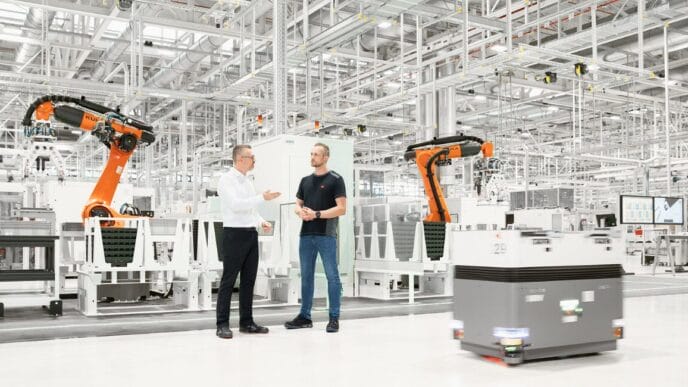
Collaboration between humans and robots is another important trend in robotics. The ability to work together with humans means that modern robotic systems are able to adapt to a rapidly changing environment.
The range of collaborative applications, The range of applications offered by robot manufacturers is constantly expanding. At present, applications with a shared workspace are the most common, in which humans and machines complete tasks one after the other - i.e. sequentially.
Applications in which humans and robots simultaneously on the same part are much more demanding in comparison. Research and development (R&D) is currently focussing on methods that enable robots to interact with humans in real time at the workplace.
Just as two people would work together in a factory, the R&D teams want the robot to be able to adapt its movements to the environment to ensure truly responsive collaboration. These solutions take into account, for example, recognising the human voice or gestures.
With today's technology, the Human-robot cooperation already offers enormous potential for companies of all sizes and industries. Investments in collaborative systems will complement traditional industrial robots.
Robots go digital
Industrial robots are the central components of digital and networked production as used in Industry 4.0. This makes it all the more important that they can communicate with each other - regardless of the manufacturer.
The so-called ‚OPC Robotics Companion Specification‘, which was developed by a joint working group of the VDMA and the Open Platform Communications Foundation (OPC), defines a standardised generic interface for industrial robots and enables the connection of industrial robots to the Industrial Internet of Things (IIoT).
The digital connectivity of robots, for example with the Cloud technology, For example, robot leasing - known as Robots-as-a-Service - has advantages that could be particularly attractive for small and medium-sized enterprises (SMEs): no capital commitment, fixed running costs, automatic upgrades and no need for qualified personnel for the robots
Further trends on the global robot market can be found on the IFR website.
[infotext icon]
About the IFR
The International Federation of Robotics is the voice of the global robotics industry. IFR represents almost 60 members, including manufacturers of industrial robots and national robotics associations from over twenty countries, and was founded in 1987 as a non-profit organisation. [/infotext]