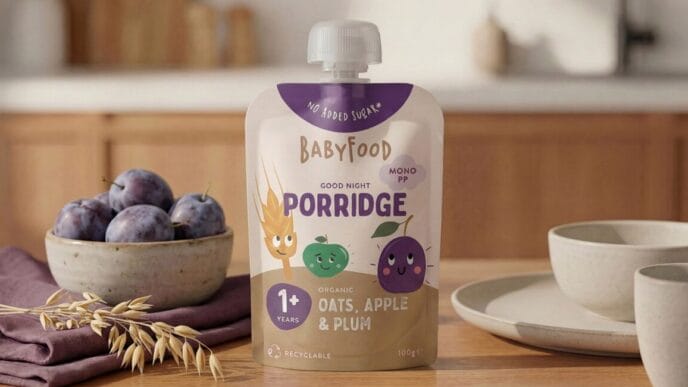
To round off the year, we once again present our most-clicked articles of 2021. 8th place: The trend show on the topic of „paper-based packaging“
Paper and cardboard are currently among the most popular packaging materials. When we report on new developments such as the paper bottle, there are an astonishing number of reactions. We therefore took a closer look at the paper packaging trend and asked: How sustainable is paper anyway?
Ever since plastic packaging fell into disrepute, industry and trade have been looking for alternatives. Paper is the most popular. But is it fundamentally environmentally friendly and ecological to pack in paper?

Not all paper is the same
The type of paper plays a key role in the environmental impact. Corrugated cardboard shipping boxes are made from around 75 per cent recycled paper, while food packaging requires more virgin fibres. More material often has to be used to give packaging comparable strength. Speciality papers or kraftliner, high-quality paper grades, perform better in terms of CO2-emissions do not perform well. So paper is just as versatile as plastic, Therefore, before any changeover, it is necessary to analyse whether it is actually more sustainable to replace a single-origin recyclable plastic monomaterial with paper.
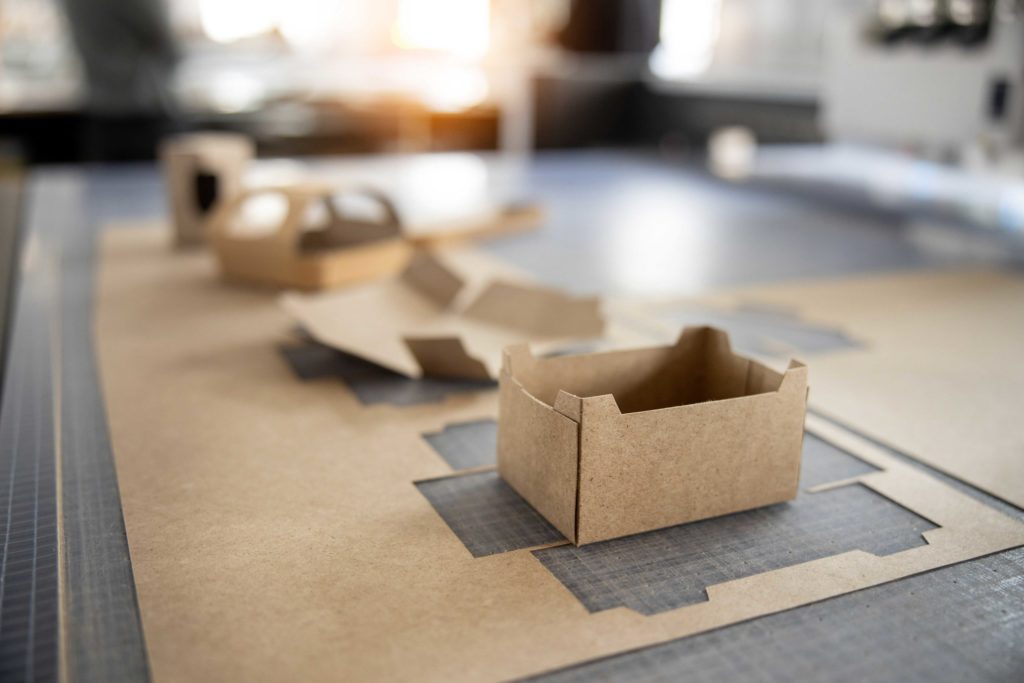
Everyone wants the paper bottle ...
... but it has not yet arrived on the market. We regularly publish reports on the planned use of paper bottles - Carlsberg already wanted to bottle its beer in them a few years ago, and Diageo announced the first whisky in a paper bottle for early 2021. However, the paper-based Johnnie Walker bottle is not yet coming, the bottler announced on request.
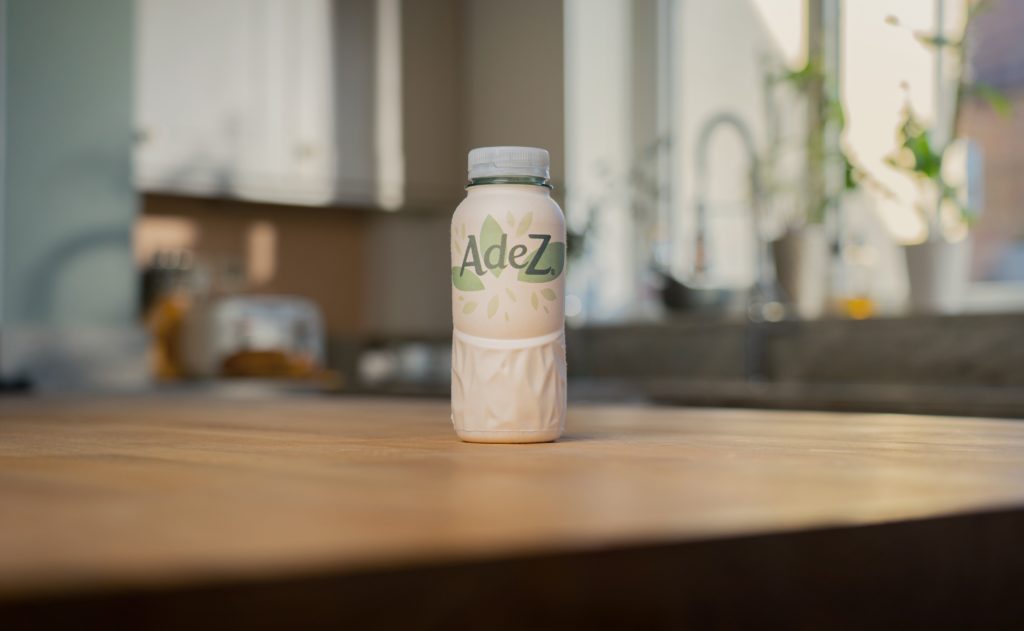
Coca-Cola will soon be starting a test run with a prototype that is still plastic-coated on the inside. The paper bottle will initially be offered to 2,000 consumers in Hungary with the plant-based drink AdeZ. The bottle was developed together with The Paper Bottle Company (Paboco), a joint venture between BillerudKorsnäs and Alpla. According to its own information, Paboco works on a coating made from bio-based material. The bottle should then be 100 per cent recyclable. A real challenge, as it needs to be resistant to liquids and CO2 and retain oxygen. If successful, it could be suitable for carbonated and non-carbonated drinks, but also for cosmetic products and more.
L'Oréal body care is already on the market in paper bottles from Ecologic Brands. A solution that, on closer inspection, is not so sustainable. Although the products in the Seed Phytonutrients range are packaged in a water-resistant paper bottle sleeve - and are therefore also suitable for use in the shower - the actual product is contained in a lightweight, thin-walled, blow-moulded plastic sleeve. This rigid Monopolymer lining consists of 80 per cent recycled, high-density polyethylene (HDPE) and is recyclable, reports the International Molded Fibre Association (IMFA). Nevertheless, the outer and inner shells are not glued, but are mechanically connected by tabs and can therefore be easily separated.
In most applications, paper cannot do without a coating. As an alternative to conventional PET or PE coatings, recyclable and compostable coatings are being developed, for example from starch. However, if the coating is thin enough, plastic-coated paper packaging is also recognised as a mono-material. Paper packaging that only has a coating in the sealing area, for example, can then be disposed of and recycled with the waste paper. In contrast to other countries, a narrow definition applies in Germany, so In Germany, paper packaging must consist of at least 95 per cent paper. exist. In Austria it is 85 per cent and in Sweden only 50 per cent to be recycled via the waste paper stream.

Is home tastability the solution?
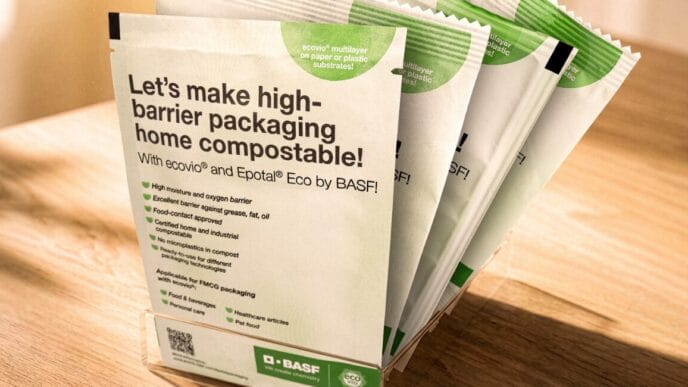
BASF and the Swedish packaging manufacturer BillerudKorsnäs have jointly developed a paper laminate for flexible packaging that can be decomposed in domestic compost. The Multilayer composite consists of three components ConFlex Silk paper from BillerudKorsnäs, a sealing layer made from the certified home compostable and partially bio-based BASF biopolymer ecovio and the water-based adhesive Epotal Eco, which bonds the film and paper. All components of the multilayer laminate are approved for food contact and are home compostable in accordance with official European certification systems. The performance characteristics should correspond to those of standard multilayer packaging: Puncture resistance, printability and heat-sealing properties. Also important: the film can be processed on standard packaging machines become.
Paper works even at sub-zero temperatures
Frosta has realised an innovative project and developed a pure paper bag packaging for the freezer that can be easily recycled in waste paper, has a lower CO2-It has a smaller carbon footprint than the plastic packaging used up to that point and decomposes easily within a few months if it does end up in the environment. The paper bag made of unbleached, uncoated paper from FSC-certified forestry does not require any plastic coatings or films and is printed with water-based colours. According to the manufacturer, it is made fit for the challenges of deep-freezing using a purely physical process. After use, the bag can be emptied and disposed of in waste paper.
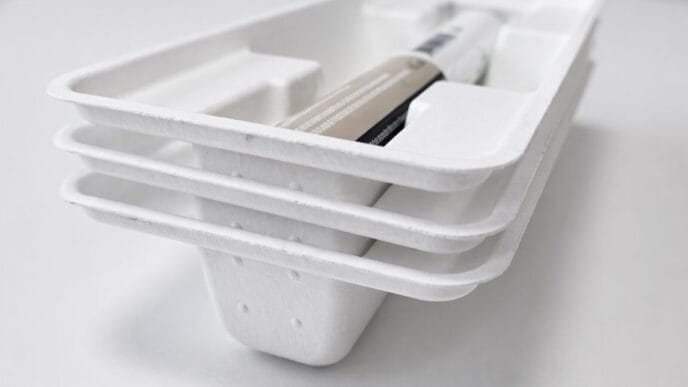
Last year, the company received an award for its innovative packaging. German Packaging Award in the sustainability category. Paper is also the new material for the packaging of Frosta gourmet fillets. Previously packaged individually in plastic film and in the classic aluminium tray, the product is now available in a paper tray with a thin PET coating. The uncoated, unbleached, natural brown paper is Suitable for preparation in the oven and microwave and can be disposed of in waste paper after use. According to the company, it saves around 500 tonnes of aluminium and 500,000 square metres of film per year.
Machine manufacturers are also switching to paper-based packaging
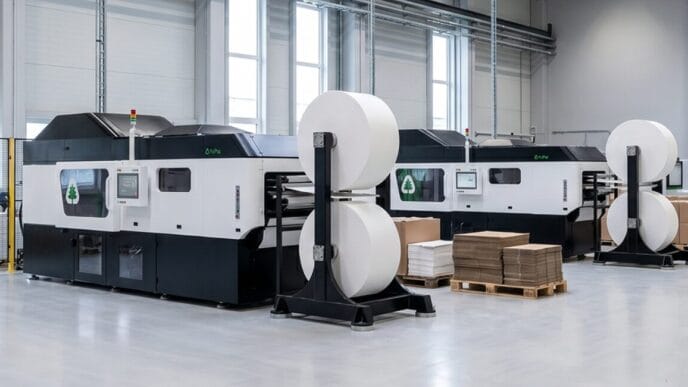
Sustainable packaging that replaces plastic with paper wherever possible is not just a question of the availability of materials. Although flexible packaging paper is competing with plastic packaging, it still has to share space with it on the packaging machine for the time being. For machine operators, the main issues are therefore changeover times, machine conversions and process reliability in processing. Syntegon Technology cooperates with paper manufacturers such as Sappi and Koehler Paper. For example, a Sappi customer was able to equip its existing tubular bag machines with the paper-ON-form retrofit kit from Syntegon and thus switch from conventional to paper-based material.

The Koehler Paper Group is also aware of the pressure consumers exert when it comes to greater sustainability. Although the development towards more sustainability is immediately desired as a revolution, it is only possible in an evolutionary way.
„We ensure that our customers can continue to use their existing machines, on which plastic multilayer and monomaterials were previously processed, with paper as well. They change the rolls - and that's it. And our colleagues at Syntegon know how to deal with temperature, pressure, friction coefficients, edges and mould shoulders. We adapt to this in paper production.“ Alexander Rauer, Product Manager at Koehler
Paper as a packaging material is still a novelty in the beverage market, but is attracting great interest from bottlers, according to KHS, which is focussing on flexible systems. For example, a new can packer packs beverage cans in cardboard, paper or film. Many Customers see wrapping in paper as an additional new option, says the machine manufacturer. „Right from the start, we've had many enquiries for machines that can process both paper and film,“ explains Ernst van Wickeren, Product Manager Packaging at KHS. „These are often bottlers who offer premium products as well as more affordable beverage variants. The high-quality products should then be wrapped in paper, while the containers in the lower price segment are held together by shrink film.“
[infotext icon]Every German consumes over 240 kilograms of paper, cardboard and carton per year, around 96 kilograms of which is packaging. This makes Germany the world leader. Most of the wood used for fibre production does not come from domestic forests, but is imported. Almost half comes from South America, of which around 54 per cent is eucalyptus wood. It takes 2.2 tonnes of wood to produce one tonne of pulp. In contrast, 1.25 tonnes of waste paper are needed to produce one tonne of recycled paper. Water consumption is also significantly lower than in the production of virgin fibre paper.The proportion of waste paper used in Germany has risen significantly in recent years. According to the UBA, the German paper industry produced around 22.1 million tonnes of paper, cardboard and paperboard packaging in 2019, using around 17.2 million tonnes of recovered paper. The proportion of waste paper in total domestic paper production was therefore around 78 per cent[/infotext].