At the end of the packaging line, a wide variety of formats have to be bundled and strapped for transport at high speed during folding carton processing. Bahmüller and Mosca have jointly developed an optimal solution for Mayer Kartonagen with the Powerpacker, in which ultrasonic sealing units are used inline for the first time.
Customised corrugated cardboard packaging solutions - that is the business area of Mayer cardboard packaging in Haiterbach. From compartment inserts to folding and die-cut cardboard boxes, the plant in the Black Forest produces thousands of packages every day for engine and transmission parts, medical technology components and, last but not least, foodstuffs. As the cardboard packaging varies enormously depending on the industry, product and area of application, it is not only a major challenge to produce it, but also to bundle and secure for transport.
For several years now, a Jetbox folder gluer (FKM) from Wilhelm Bahmüller Maschinenbau Präzisionswerkzeuge GmbH has been automatically sealing and gluing the various types of packaging at Mayer Kartonagen. Until recently, employees manually removed the boxes at the end of the production line, separated and turned them and then fed them to the bundling unit: a laborious and time-consuming process that limited the productivity of the line. The full capacity of the FKM could not be utilised in this way and large bundles were difficult to strap. In order to optimise this process, Mayer Kartonagen teamed up with the companies Bahmueller and Mosca two long-standing partners and specialists on board.

Simple and efficient bundling and strapping
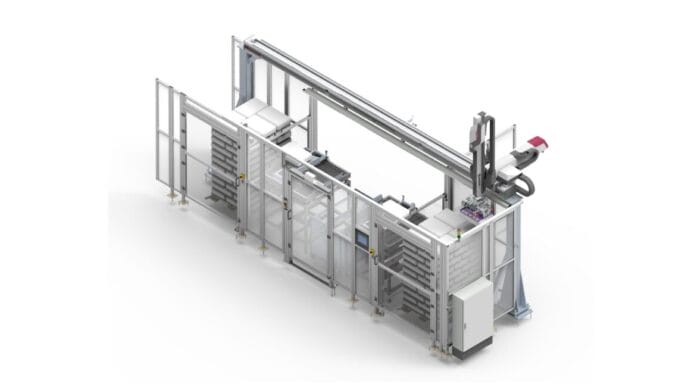
The result of the collaboration is impressive with the ultra-modern Powerpacker with SoniXs inline units. Glued cartons are fed fully automatically from the FKM into the Powerpacker, sorted into bundles and finally strapped. This saves time and gives Mayer Kartonagen's productivity a new boost. Depending on the number of items per bundle, the Powerpacker straps between 7,800 and 13,000 blanks per hour. Maximum output is 20,000 packages. Depending on the pack shape, the corrugated board processor achieves an increase in output of 20 to 35 per cent. Aziz Kaplan, Production & Technology Manager at Mayer cardboard packaging, says that „... the Powerpacker with SoniXs ultrasonic technology is a clear step into the future for the production line.“
At the end of the packaging line, the operator only has to specify the number of packs per bundle and set the size of the cartons, then the machine takes over. The shingled flow of cartons is fed directly from the FKM to the Powerpacker via a press belt. Sensors count the cartons there. As soon as the selected number has passed through, a separating belt divides the shingled cartons.

For packs with an automatic base, the Powerpacker's turning module then ensures homogeneity: a partial pack is turned through 180 degrees. These cartons fall onto the unrotated cartons in the collection chute and form a uniform pack that can be easily stacked. From the chute module, the packs are pushed into the strapping module.
Inline strapping for the first time
The machine at Mayer Kartonagen is a first: it is the first Powerpacker to utilise Mosca's ultrasonic technology in an inline strapping machine. „This development differs significantly from our other SoniXs units,“ explains Christian Zwieb, Sales Manager Mosca Engineering at Mosca. „In order to be able to use SoniXs technology in the Powerpacker, we had to develop completely new units that are mirror images of each other.“
To the Strapping a linear plunger moves into the unit from above and picks up the strapping. To seal the strap, the sonotrode then swings in from below, presses the strap ends together and seals them with single or double five millimetre wide PP strap as required. The units are equipped with a double dispenser. This ensures a continuous supply of strapping by a sensor that recognises an empty roll and automatically welds on the next roll without idling.

With these new inline units the Powerpacker is perfectly prepared for the various pack formats required by Mayer Kartonagen, regardless of whether they are small or display packs. With a minimum distance of just 100 millimetres between the two strapping units and a collating chute height of 400 millimetres, packs of almost any size can be processed reliably.
Cooperation as a success factor
To ensure that the Powerpacker would work reliably with the new units right from the start, Mosca and Bahmüller developed the machine in close collaboration: „We developed the first Powerpacker with the support of Mosca and have been in constant dialogue ever since,“ says Bahmüller. Christoph Gutmann, Product Manager Corrugated Board Processing at Bahmüller. When the shaft height needed to be increased by more than 40 per cent for the fourth generation of the Powerpacker, Bahmüller turned to Mosca again. „Some strapping machines can't handle a height of 400 millimetres - but Mosca's machines can,“ explains Gutmann.
After development, Bahmüller finally tested the Powerpacker with Mosca modules for four months in the own innovation centre also with products from Mayer Kartonagen. „We supported the project together from the very beginning: from the concept to development and integration, we were always in dialogue with Mosca and Mayer Kartonagen,“ emphasises Gutmann. „This close collaboration between all three parties was definitely the key to success.“
Challenging installation pays off
An entire line at Mayer Kartonagen had to be relocated for the installation of the Powerpacker. The biggest challenge of the project was the effective co-operation between the fitters of the three companies involved. The effort was worth it: „We are very satisfied with both the project process and the performance of the entire production line. The Powerpacker is stable and efficient and makes the work much easier,“ says Aziz Kaplan, summarising the result. Mayer Kartonagen is already Further expansion stages of the line and is planning, for example, a Fully automatic material removal.