The Institute for Packaging Technology (IfV) in the Association for the Promotion of Innovative Processes in Logistics (VVL) e. V. was founded in 1985 to develop sustainable solutions in the field of logistics, particularly in co-operation with small and medium-sized companies, through practice-oriented research, development and testing of packaging.
Since then, in addition to carrying out FE projects, the IfV has been involved in testing the practical suitability of packaging solutions and their optimisation. The focus here is primarily on Packaging used in transport, handling and storage processes, to both improve the handling of the packaged products and ensure their protection. In addition to standardised test procedures and recognised industry- or company-specific methods, test procedures that take into account the client's special features are also developed and applied in collaboration with the client.
Practical packaging tests in the PackLab®
In the IfV PackLab® test laboratory, a wide range of test equipment is available to verify the practical suitability of packaging. In addition to the universal testing machine with 10 kN tensile or compressive force for materials and smaller packaging, the electromechanical compression press with 200 kN compressive force is primarily used to test stacks for block storage or pallet certification, but with its feed rate of 0.2 to 500 mm/min it also allows other tests to be carried out. To simulate the Shock sensitivity of goods in case processes and for determining the Shock absorption A shock test system is available for testing packaging cushions. Impacts and accelerations are recorded with three-dimensional acceleration sensors to provide information on the quality of the packaging. This system is most frequently used to test shipping packaging to qualify it for safe transport in accordance with the guidelines/specifications of CEP service providers such as UPS or DHL.

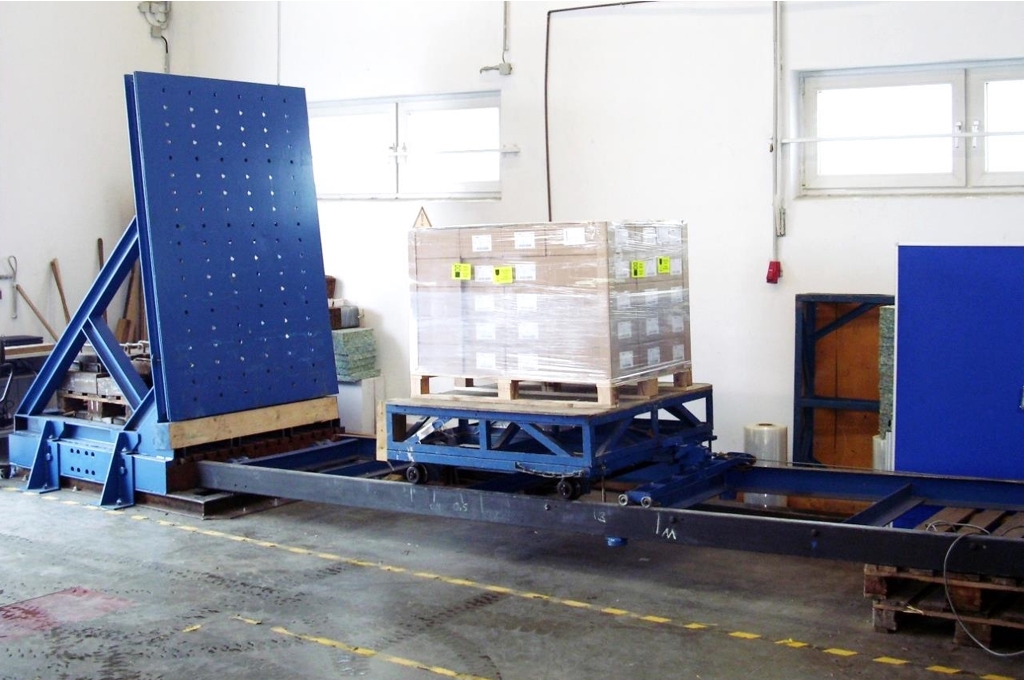
The possibility of simulating vibration and impact loads is of great practical relevance for simulating transport loads in all modes of transport. Vibration tests allow conclusions to be drawn about the stability of a stack, the effectiveness of the LE fuse or the durability of screw and solder connections during transport. In addition to a vibration table in the climate chamber - and according to the IfV, this is unique - another electrodynamic vibration table is available for harmonic and stochastic vibrations with a frequency spectrum of 5 to 2,000 Hz, which also enables horizontal vibration and shock excitation. PackLab® also has an electrodynamic vibration table for harmonic and stochastic vibrations with a frequency spectrum of 5 to 000 Hz. Horizontal impact testing system („inclined plane“), which allows analyses of the effect of impact loads on the product, packaging and LE securing.
Benefits from the packaging inspection
From the outset, the generalisable findings from the audit and other IfV work were the starting point for Publications or flowed into Standards and guidelines projects, The IfV is also a member of the VDI Society for Production and Logistics' expert committee 308.1 Packaging Logistics. In addition to carrying out, analysing and documenting packaging tests, the IfV also offers Consultations on customer-internal packaging processes, structures and quantities, for the optimisation of existing packaging systems and the development of new ones. In addition to packaging tests on behalf of industry, the PackLab® test facilities are also used for publicly funded research, with the content ranging from the development of packaging and load carriers to the optimisation of AutoID elements and the testing of LE and load securing devices. For example, the effects of climate on the quality of anti-slip mats and the performance of transponders were analysed for the first time.
Contact:
Institute for Packaging Technology of the VVL e. V.
Giselherstr. 34
44319 Dortmund
Jörg Loges
Phone: +49 (0)231 560779 81
e-mail: j.loges@vvl-ev.de
http://www.vvl-ev.de