Bobst: 125 years of innovation in packaging production
In spring 2016, BOBST celebrated its 125th anniversary. Ultimately, the history of the group of companies reflects the development of modern packaging production - BOBST has repeatedly set milestones in this industry with pioneering innovations.
10. July 2018
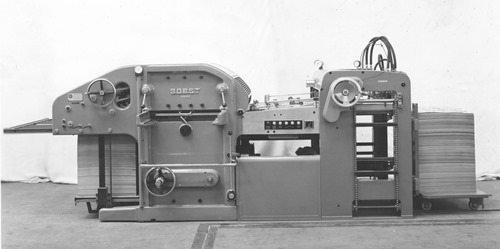
The first BOBST flatbed die-cutter SP 1080 Autoplaten is produced in 1950 and soon 1,000 units are sold.
Bobst celebrated its 125th anniversary in spring 2016. Ultimately, the history of the group of companies reflects the development of modern packaging production - Bobst has repeatedly set milestones in this industry with pioneering innovations.
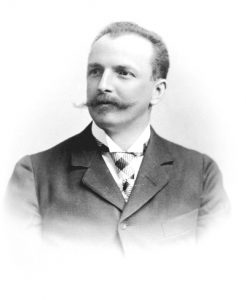
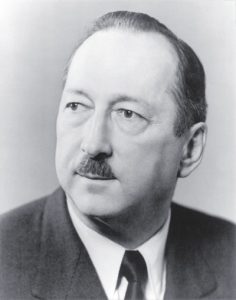
Here are some key moments in the history of the group of companies, which is now represented in more than 50 countries and employs almost 5,000 people worldwide. The Bobst story begins on the threshold of the 20th century. 1890 Joseph Otto Bobst (1862 - 1935) opened a printing supplies shop in Lausanne and began selling printing inks manufactured by Gebrüder Schmidt from Bockenheim near Frankfurt am Main. In December 1897, Henri Bobst was born, a talented technician and visionary who would later play a key role in driving the company's industrial development.
Founder Joseph Bobst (1862 - 1935).
Visionary Henri Bobst (1897 - 1975).
In 1904, Joseph Bobst moves into larger business premises in Lausanne as he is very successful with the sale of printing accessories and now also repairs machines. He employs three technicians and starts selling used machines and manufacturing tools for printing.
The first world premiere
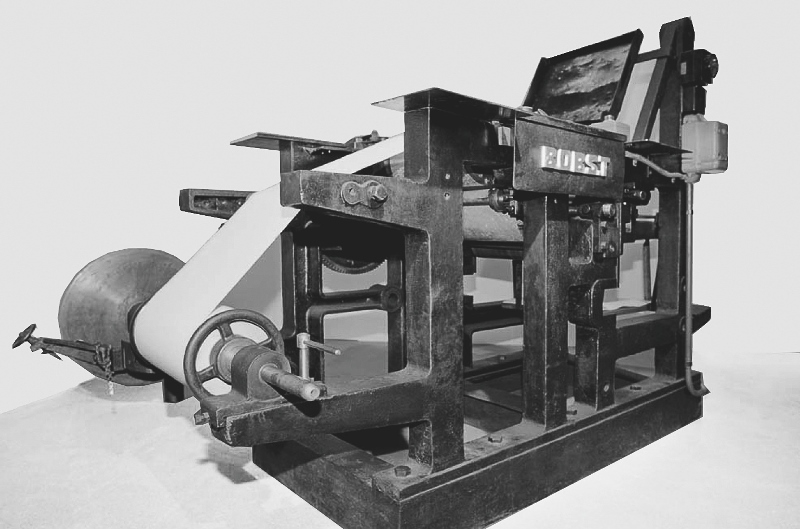
After meeting the director of the home for the blind at the age of 15, Henri Bobst developed the The world's first embossing press for printing Braille on both sides of paper. This rotary machine outputs several thousand pages per hour and is the first major success. In 1917, the BOBST logo is created as an unmistakable trademark of the mechanical engineering company.
First Bobst embossing press, around 1912.
After the end of the First World War, the company changed its name to J. Bobst & Fils (Joseph Bobst and Sons) in 1918 and presented machines for processing cardboard at an international trade fair in Lyon. In 1921, Bobst sets another milestone with the introduction of the MR2BA, a new type of machine for die-cutting large-format cardboard sheets that can be set up in record time.
In 1934, at the Foire de Paris trade fair, the Prototype of the Premiere autovariable. This machine punches and prints cardboard boxes in a single work step. It can be flexibly adjusted to different formats. Four years later, Bobst enters industrial production with the opening of the factory in Prilly near Lausanne. In 1940, the company celebrates its 50th anniversary and revolutionises the die-cutting and creasing of cartons with the Bobst AP900 Autoplaten. The AP900 Autoplaten is the The world's first automatic punching machine and processes more than 4,000 sheets per hour. The PCR 382, the first folder-gluer, followed in 1942. It combines various technologies and emphasises the enormous potential for innovation.
In 1940, Bobst revolutionised the die-cutting and creasing of cardboard with the AP900 Autoplaten. It is the world's first automatic die-cutting machine and processes more than 4,000 sheets per hour.
Sales successes
The product range is well received by the market, which is reflected in its growth. Just one year after the end of the Second World War, Bobst already employs 200 people. In 1950, the company introduces the SP 1080 Autoplaten flatbed die-cutter, the first machine to combine the performance features that the Bobst name still stands for today: experience, unrivalled quality and productivity, and easy maintenance.
Six years later, the SP 1260-E, which can be configured in various versions for die-cutting and (hot-foil) embossing, is setting new standards. It processes cartons up to a format of 1,260 mm x 920 mm and opens up new possibilities for packaging manufacturers in the packaging industry. Refinement. In 1951, BOBST exhibits at drupa for the first time and sells 43 machines there.
Automation quickly gains importance in the packaging market. A milestone is reached in 1961: Bobst announces the sale of its one thousandth autoplaten. This figure increases fivefold by 1982. At the end of the 1960s, there is no longer enough space in Prilly. In 1970, the company acquires 300,000 m2 of land for its future expansion at its current site in Mex, a few kilometres outside Lausanne. The first building was inaugurated in mid-April 1977. One year later, J. Bobst & Fils SA becomes Bobst SA., which has since been listed on the Lausanne stock exchange.
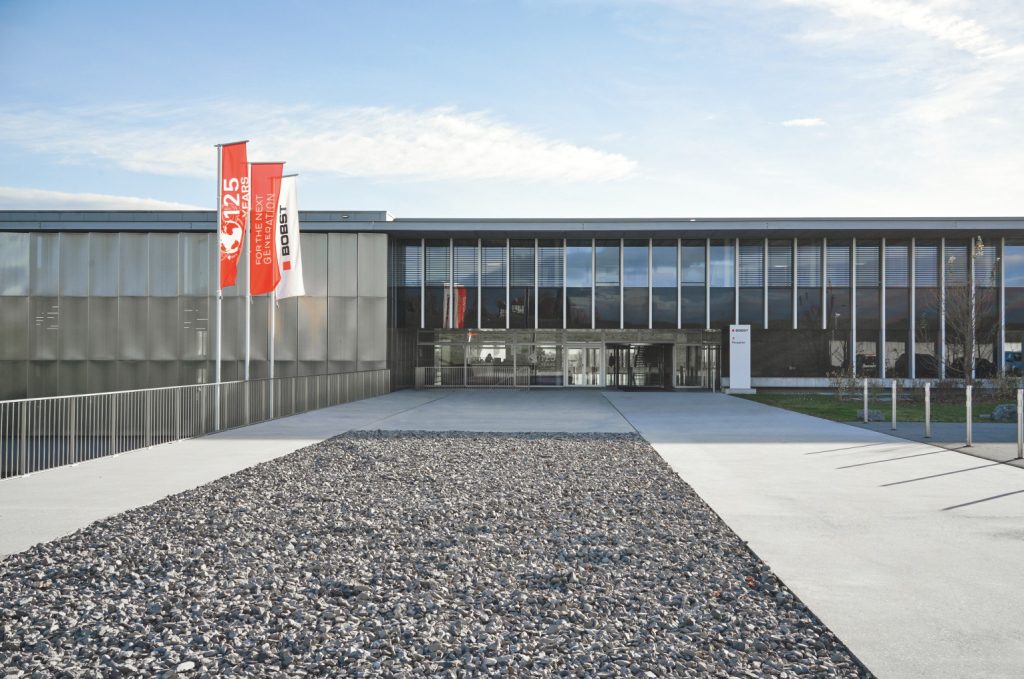
The Bobst headquarters in Mex, a few kilometres from Lausanne.
Increasing internationalisation and expansion of the portfolio
Since the middle of the 20th century, BOBST has been positioning itself more internationally. Acquisitions and foreign companies strengthen the global presence and complete the portfolio for all areas of the packaging market. The takeover of the US company CHAMPLAIN from Roseland/New Jersey marks the start of the development of a strong US sales network. In the same year, BOBST founds Italia SpA in Milan, followed in 1971 by today's Bobst Japan Ltd. A year later, the first plant is opened in Brazil.
Other highlights include the founding of Bobst Canada in 1979, the opening of a new plant in Mauá in Brazil in 1980 and the acquisition of the French company Martin S.A., now Bobst Lyon, and the German company Peters Maschinenfabrik GmbH. Strategic acquisitions that paved the way for entry into the production of Packaging made from corrugated cardboard mean. The company is becoming a full-service provider here.
In 1987, BOBST acquires a stake in the Italian company Schiavi SpA, which specialises in the printing and coating of flexible materials - its entry into the flexible packaging market. Thirteen years later, BOBST takes over this company completely. In 1990, Bobst Meerbusch is founded, since then an important contact point for customers of the Folding carton and corrugated board industry from Germany and the Benelux countries. Meerbusch is also the central service hub for customers from this region and, as a competence centre, an easily accessible location for training courses and machine demonstrations.
The takeover of Asitrade AG, now Bobst Grenchen, in 1993 marked the company's entry into the market of Inline laminating machines. In the following years, BOBST expands its global presence with subsidiaries in Asia, Africa, (Eastern) Europe and a plant in India. In 2004, BOBST acquires the companies Atlas, Titan, Midi, General Vacuum Equipment and Rotomec, based in the UK and Italy, which produce flexo and gravure printing machines as well as coating and laminating systems, from the Metso Group. They complement the portfolio of the now fully integrated Schiavi company. BOBST now has all the expertise needed to develop innovative solutions for processing flexible materials. Fischer & Krecke GmbH, which specialises in flexographic printing, is added in 2008. These acquisitions give rise to Bobst Bielefeld, Bobst Italia and Bobst Manchester. The most recent addition in 2015 is Nuova Gidue, a printing press manufacturer for the narrow and midweb sector, now Bobst Firenze.
Jean-Pascal Bobst
„The key difference between a good performance and an outstanding performance lies in always living up to your values and taking all the interests involved into account. These are also our priorities when it comes to shaping the future,“ emphasises Jean-Pascal Bobst, CEO of the Bobst Group.
Productivity, efficiency and flexibility are becoming increasingly important
Since the mid-1960s, Bobst has been introducing one ground-breaking technical innovation after another, with which the company penetrates further market segments and lays the foundation for its current market position as a full-service provider of solutions for the production of all types of packaging: in 1965, the very simple, robust and reliable SP 1420-E AUTOPLATEN flatbed die-cutter for larger cardboard sheet formats and, in 1968, the CORSAIR 940/1225, the first Swiss-made Champlain gravure printing machine specifically for flexible packaging. In 1974, the LEMANIC 1425, a web press with an innovative design and advanced technology for processing large runs of cardboard packaging, celebrated its première.
In 1982, Bobst introduces its latest autoplaten machine, the SP 102-CE. With its innovative technologies, it is the world's first die-cutter with an output of more than 10,000 sheets per hour. Four years later, the Domino, a folder-gluer for lockbottom cartons, is launched on the market, and the first Cartonpack automatic packer packs folding cartons into shipping cartons more efficiently than ever before. The trend is clear: productivity and efficiency are becoming key factors for success in packaging production. Increasingly, innovations also came from the acquired companies, e.g. the computerised inliner 1330 Superline FFG for the corrugated board industry in 1989. This was followed in 1993 by the DRO 1624 rotary die-cutter, which was extremely productive by the standards of the time.
Since the early 1990s at the latest, another trend has been emerging in the packaging industry: packaging manufacturers are increasingly basing their investment decisions on the Ease of use and on short Set-up times. The same applies to the availability of machines, which are now often used around the clock. Bobst is responding to this trend with pioneering developments and in 1992 introduced C.U.B.E. (Control Unit Bobst Electronic), an innovative user interface developed in-house for its machines, which significantly simplifies their operation.
Demonstration of the possibilities for maintenance and troubleshooting at drupa 2016.
The SP 76BM hot foil stamping machine celebrates its premiere in 1995. It allows quick job changes and, with its control systems, enables reliable production with consistent quality. In 1998, the Alpina folding carton gluing machine with the Gyrobox turning module is launched, allowing complex folding cartons to be produced in a single work step. Flexibility in packaging production is also becoming increasingly important for customers. In 2000, BOBST sets another world record with the SPrintera 106 PER Autoplaten flatbed die-cutter. The machine processes 12,000 sheets per hour.
After the turn of the millennium
In the first decade and a half of the new millennium, Bobst continued to produce a firework display of innovation in all product areas. Many of the machines presented during this time are part of the current product portfolio, many of them in a further developed form. As recently as drupa 2016, Bobst emphasised its innovative strength with the presentation of six outstanding new products. The company is also pursuing the goal of taking a leading role in the market with innovative solutions for digital technologies. For example, BOBST has been making headlines since 2012 with its pioneering machine for digital printing on corrugated cardboard, which won the FEFCO gold medal. Two of these machines are now in operation at customers.
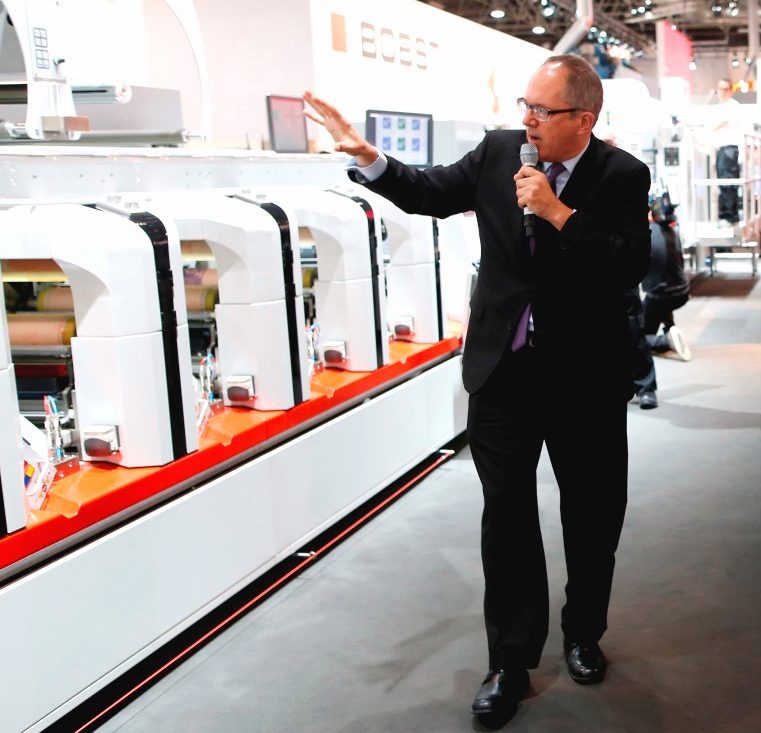
Presentation of the M6 Digital Flexo press at drupa 2016.
And at drupa 2016, the company celebrated its M6 Digital FlexoTM an innovative inline UV printing press for the production of folding cartons and flexible packaging made its world debut. It features 9-colour UV flexo printing and a web width of 670 mm and enables job changes within a few minutes with only a few metres of waste. Thanks to the implementation of Digital FlexoTM (this technology uses the same seven colours for all jobs), the colours can be printed in the extended colour space.
One Group, One Brand
A milestone in Bobst's history was the appointment in May 2009 of Jean-Pascal Bobst as the new CEO. He is the fourth generation of his family to lead the Group. With the Group Transformation Programme, he set the strategic course for further positive development at the height of the global financial and economic crisis in 2009. One of the most important measures was the restructuring of the Group into the Sheet-fed, Web-fed and Services divisions, while at the same time optimising all business processes. Under the motto „One Group, One Brand“ BOBST also gave itself a new corporate identity.
Partner to global packaging manufacturers
A central feature of the Bobst story has always been the Close, cooperative partnership with customers. Time and again, the company (which now holds over 1,350 patents) has provided the packaging industry with new ways of meeting the demands of the market. pro-active to fulfil. Thanks to its broad product portfolio, Bobst can supply equipment for processing more than 50 per cent of all packaging production. On the other hand, many customers have driven development at Bobst with innovative ideas and new requirements. A permanent give and take that no other manufacturer in the industry has experienced in this form over such a long period of time - and continues to do so.