
BASF has been active in the field of bioplastics for more than 30 years and this year celebrates the 25th anniversary of ecoflex, the first commercially available biodegradable and certified compostable biopolymer on the market. Since then, the company has developed various certified compostable and biodegradable plastics that are can be used in packaging and agricultural applications, to achieve a complete circular economy for plastics. Mia Pettersson and Afsaneh Nabifar are working on this in Ludwigshafen. We spoke to these two committed women about innovations and the opportunities for bioplastics in these sectors.
It is already working well in some areas - for example, for some time now Biodegradable polymers for the production of mulch films in agriculture used. The films are completely biodegradable after some time without contaminating the soil with plastic. The compostability of food packaging is another important point, says Afsaneh Nabifar, Head of Global Advocacy and Sustainability for Biopolymers at BASF:
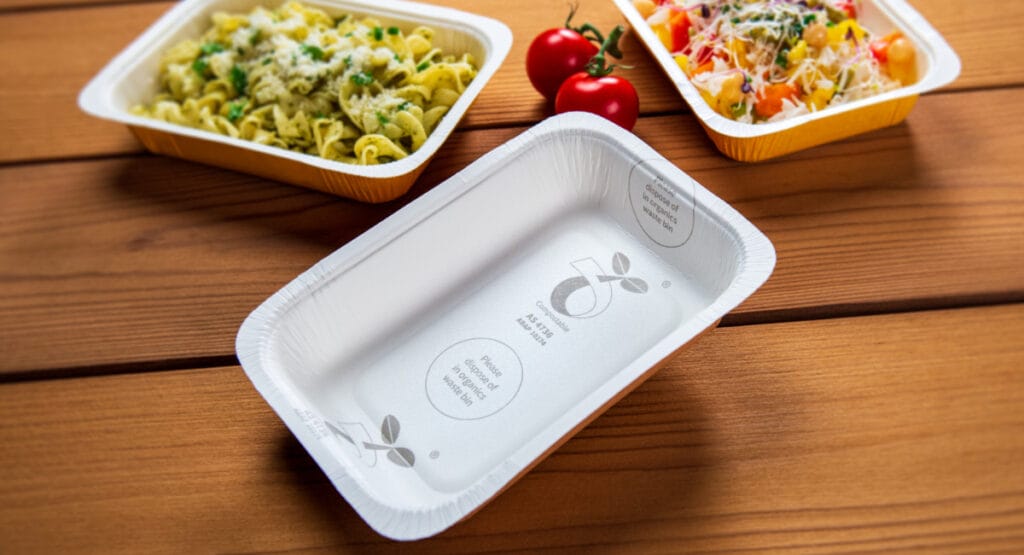
„In collaboration with customers and partners, we are constantly developing new compostable food packaging that helps to ensure that food waste and food-contaminated packaging is no longer sent to landfill or incinerated, but rather to organic recycling. In this way, the packaging acts as a carrier for the food waste and its nutrients can remain in the cycle and return to the soil.“
No patent remedy for every problem
It is important to recognise that not all food packaging can be replaced by compostable alternatives. Rather, it is about the coexistence of different solutions and to make decisions based on scientific life cycle analyses, says Nabifar. „Our team is working on certified compostable alternatives to conventional plastics because we see them as part of the solution. We see bioplastics as a supplement to existing recyclable plastics, to achieve BASF's circular economy goals,“ explains Mia Pettersson, Vice President of BASF's Speciality Polymers global business unit.
Overall, bioplastics still have a small share of the total plastics market and make up around 1 per cent of the approximately 390.7 million tonnes produced in 2022. However, the latest market data compiled by European Bioplastics and the Nova Institute indicate growth of 1.5 to 2 per cent by 2027.
„Even though the market is growing, bioplastics are still niche products for specific applications where their use offers clear benefits for the environment and human health.“
Afsaneh Nabifar
Unutilised potential
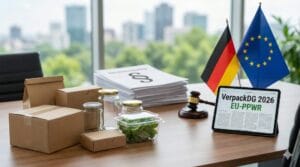
The two experts see great potential for the use of certified compostable polymers not only in the collection of biowaste or fruit and vegetable bags, but also in other areas such as the recycling of waste. Packaging applications, for example for food packaging made of paper. The plans of the European Commission with the latest revision of the Packaging and Packaging Waste Regulation (PPWR) an important role. Basically welcome the Commission's proposals to require some food packaging to be compostable. However, the list of affected products is rather limited:
„Tea bags, coffee capsules, labels for fruit and vegetables and very lightweight plastic bags should be compostable under the new proposal. We believe that this list can and should be expanded so that more innovative solutions can be brought to market.“
Afsaneh Nabifar
Recycling as a problem?
One issue that goes hand in hand with the spread of compostable material is organic recycling. Afsaneh Nabifar reminds us that Each country has a different infrastructure for the recovery of resources, resulting in different rules for the disposal of these materials. leads. Other countries in the EU, she says, recognise the benefits these materials bring to the circular economy and are therefore more open and have more experience of processing these materials in organic recycling plants. This shows that there is No inherent problem with the organic recycling of compostable materials are available. Single-use plastic bags have been banned in Austria since 1 January 2020.
„Our neighbours in Austria have exempted bio-based and biodegradable, very lightweight carrier bags for fruit and vegetables from this ban. This legislation goes hand in hand with the Bio-Kreislauf-Sackerl initiative of the Austrian Biogas and Compost Association. This has resulted in the collected municipal organic waste being significantly less contaminated with plastic. Other countries such as Italy, Ireland and parts of Spain allow certified compostable materials in organic waste and recycle them organically.“
„We know that we need a suitable infrastructure for the systematic collection of organic waste, the willingness of composters to accept the certified compostable products and a supportive EU-wide legal framework.“ Afsaneh Nabifar explains that BASF is active in several initiatives to better understand the processes and find common solutions. It is also important to create greater awareness among consumers and encourage them to collect organic waste and put packaging in the right bin. „Several studies have been carried out over the years that show that the The quality and quantity of organic waste increases when compostable bags are used and consumer awareness is increased.“
„In my opinion, this requires an appropriate change process in terms of mindset and infrastructure. We are convinced of the environmental benefits of these materials and that a circular economy can be achieved by utilising the benefits of compostable material. Now we need more players to support the transition, invest and work together to bring about change.“
Mia Pettersson
- https://biopolymers.basf.com/
- https://plasticseurope.org/wp-content/uploads/2022/10/PE-PLASTICS-THE-FACTS_V7-Tue_19-10-1.pdf
- https://www.european-bioplastics.org/market/
- Plastic bag ban voted through (bmk.gv.at)
- Advantages of the BKS - Biosackerl
- A.R.M.E.N. e.V. (2022): Nico Arbeck, Julia Lehmann, Nadine Sporrer, Ursula Peintner Witzenhausen-Institut für Abfall, Umwelt und Energie GmbH: Dr-Ing. Michael Kern, Hans-Jörg Siepenkothen: Final report on the pilot project, practical test of organic bags - circular economy with compostable fruit and vegetable bags, project duration: 01.12.2020 - 28.02.2022, https://www.carmen-ev.de/wp-content/uploads/2022/02/Abschlussbericht_Praxistest-Bio-Beutel.pdf
- Helmut Schmidt, Gerald Stutz, Dr Timon Gruber (2017): Practical trial to increase biowaste collection in Munich, Müll & Abfall, issue 2-2017, https://www.muellundabfall.de/ce/praxisversuch-zur-steigerung-der-bioabfallerfassung-in-muenchen/detail.html
- Kanthak, Manfred; Söling, Frieder: Evaluation of the use of compostable collection bags made from ecovio® material. Müll und Abfall 8-2012, p. 402ff, https://www.muellundabfall.de/ce/bewertung-des-einsatzes-von-kompostierbaren-sammelbeuteln-aus-ecovio-material/detail.html
- Kern, Michael; Siepenkothen, Jörg: Biowaste potential in household waste. Müll und Abfall 7-2014, p. 356 ff, https://www.muellundabfall.de/ce/bioabfallpotenzial-im-hausmuell/detail.html
More news from the magazine


Packaging machine manufacturer in flow

Powerful automation for mills

Decentralised signal processing with the Schmersal Safety Fieldbox

One hundred years blue tin