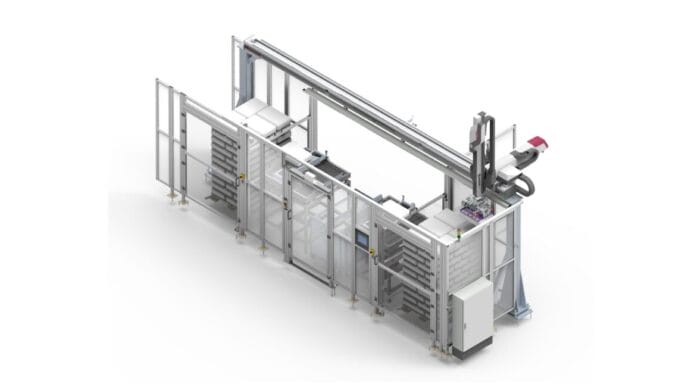
Two major topics are currently occupying the minds of decision-makers at German production companies: Industry 4.0 and the Internet of Things. At Elried, the Ci5000 series is a prime example of this. It comprises a family of continuous inkjet systems that cover all size classes, from solutions for very small series to high-speed systems.
Industrial labelling systems and in particular the inkjet systems that dominate them play an important role for both Industry 4.0 and the Internet of Things. Not only are they part of almost every production system and therefore, by definition, part of the communication chain. They also play a Key position This is because printed codes often enable machines to communicate with each other and each individual part retains its printed individuality and „intelligence“ even after leaving the factory.
Labelling specialist Elried explains how it deals with these complex issues in the interests of its customers Bastian Hofberger, Head of Sales the Elried marking systems GmbH, Oberhaching.


pj: Mr Hofberger, German Chancellor Angela Merkel also confirmed once again at the opening of the Hannover Messe that the future of German industry is closely linked to these issues. However, although everyone involved agrees on this, it is often not entirely clear how exactly this can be realised.
Bastian Hofberger: Summarised in a few words Industry 4.0 above all, better coordination and communication between the individual machines in the production process. This is intended to more efficient and simultaneously more flexible production enable. The Internet of Things in turn demands more intelligent machines that utilise and process the flood of available data and communicate with the outside world themselves.
pj: Your company is virtually predestined for this type of output. What „can“ your inkjet systems do, for example?
Bastian Hofberger: Elried has been focussing on this topic for three years now and has therefore increasingly geared its inkjet systems towards these new requirements. With the now presented Ci5000 series and the associated Elried Control Centre this development is being driven forward even further. The user interface of the Ci5000 series removes a barrier in the interaction between man and machine right from the start: On the one hand, the system can be controlled via one of the most modern touchscreens on the market.

The high-resolution and high-colour display allows Optimum readability under all conditions. The precision of the touchscreen enables accurate user input and the impact-resistant glass surface prevents damage and accidents. In addition to the large touchscreen, the machine can also be also from any PC in the network can be controlled directly. This means that the user no longer has to operate the machine themselves, but can move freely around the factory, monitor the status at any time and intervene if necessary. Full integration into Industry 4.0 and the Internet of Things takes place in the second step via the associated Elried Control Centre.
pj: How does the labelling technology interact with the control centre?
Bastian Hofberger: The machines are controlled by Network cable or WLAN are integrated into the company network and, together with the control centre, form an intelligent component of production. This intelligence is based on four central components central management of print data, monitoring of machines and upstream and downstream processes, historisation of data and user monitoring.

pj: How do the other three components work?
Bastian Hofberger: The machines can be monitored from any PC in the network, as well as from tablets or mobile phones. This can also Sensor data from upstream and downstream machines integrated and the Print image be aligned to these. The data collected from the sensors, the print text and results as well as all changes to the stored templates are aggregated in a database and can be analysed at any time - all within the framework of user monitoring, in which each employee can be given different rights to control, monitor and change the printers and print data.
pj: A Ci5000 inkjet system is therefore no longer just the final stage of production, which is used to briefly print the best-before date or the batch. Rather, it is the central part of production and a key component on the way to modern manufacturing.
Bastian Hofberger: That is correct. In addition to the Control Centre, the Ci5000 series can also handle all new, common 2-D coding printing, in particular DataMatrix- and also QR codes. These can contain links to websites or an individual code that is different for each product. Using this individual code, each product can be identified again at individual level at any time during production. Subsequent machine processing steps can thus be customised. Even long after the product has left production, it can still be clearly identified and thus also its trade and transport route. The Counterfeit protection can thus be increased, especially in combination with new, non-visible UV inks.
Elried at the interpack 2017: Hall 12, Stand B25