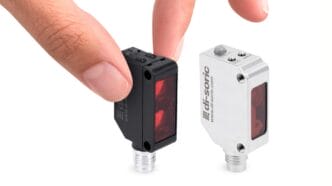
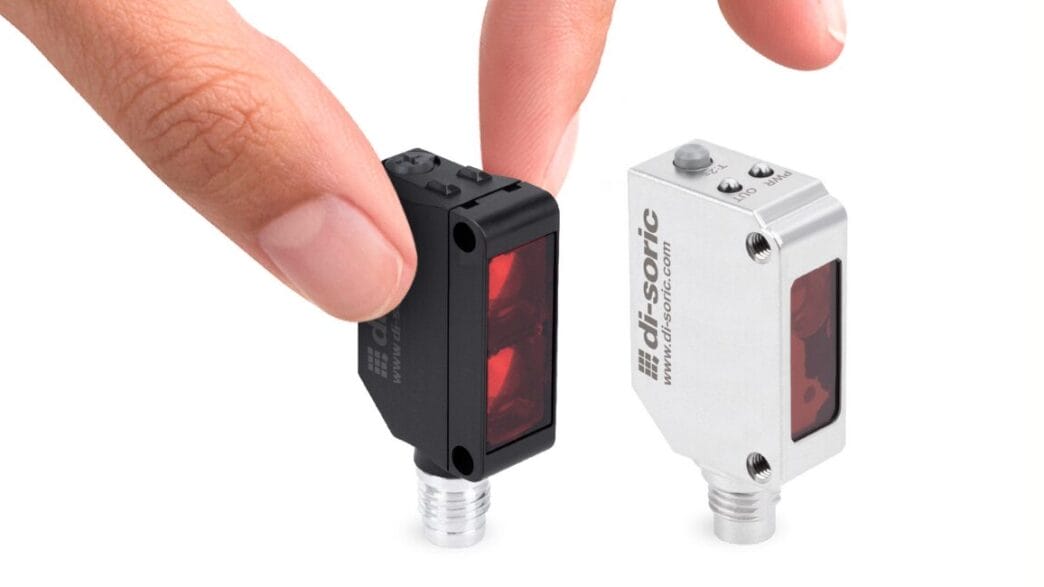
The new O-33 and O-34 series optical sensors from di-soric combine compactness, versatility, and high performance. They find their field of application in material supply, assembly, handling, as well as in packaging and filling technology. A total of 36 device variants are available to industrial users, offering a suitable sensor for almost every optically solvable task.
di-soric's optical sensors are capable of functioning reliably in various industrial environments. Their applications range from material feed to assembly and handling technology, as well as packaging and filling technology. The sensors are available in both stable plastic and robust stainless steel housings, enabling their use under extreme environmental conditions.
A practical example of their application is their use in a fully automated packaging process, where hygiene products are transported from a conveyor belt to the cartoning station. The primary packaging has changing designs, sometimes has shiny surfaces, and is occasionally fitted with stickers. In the fully automated packaging process, two Flex-Pickers take on the task of reliably and quickly gripping the bags and transporting them from the belt into prepared cartons. It is crucial here that the sensors reliably detect the objects, providing the delta robots with the signal to grip. The new sensors from di-soric ensure this reliability, thereby contributing to the efficiency of the entire process.

Simple commissioning and adaptation
Another advantage of the new sensors is their simple commissioning. The OH34-LR type laser retro-reflective sensor can be set up in just a few seconds. The intuitive operation via the teach button allows the distance to the object, a switching window, or the Deviation Detection Mode (DD-Mode) to be learned quickly and easily. Alternatively, the sensors can also be set up via cable or IO-Link, offering even greater flexibility and transparency.
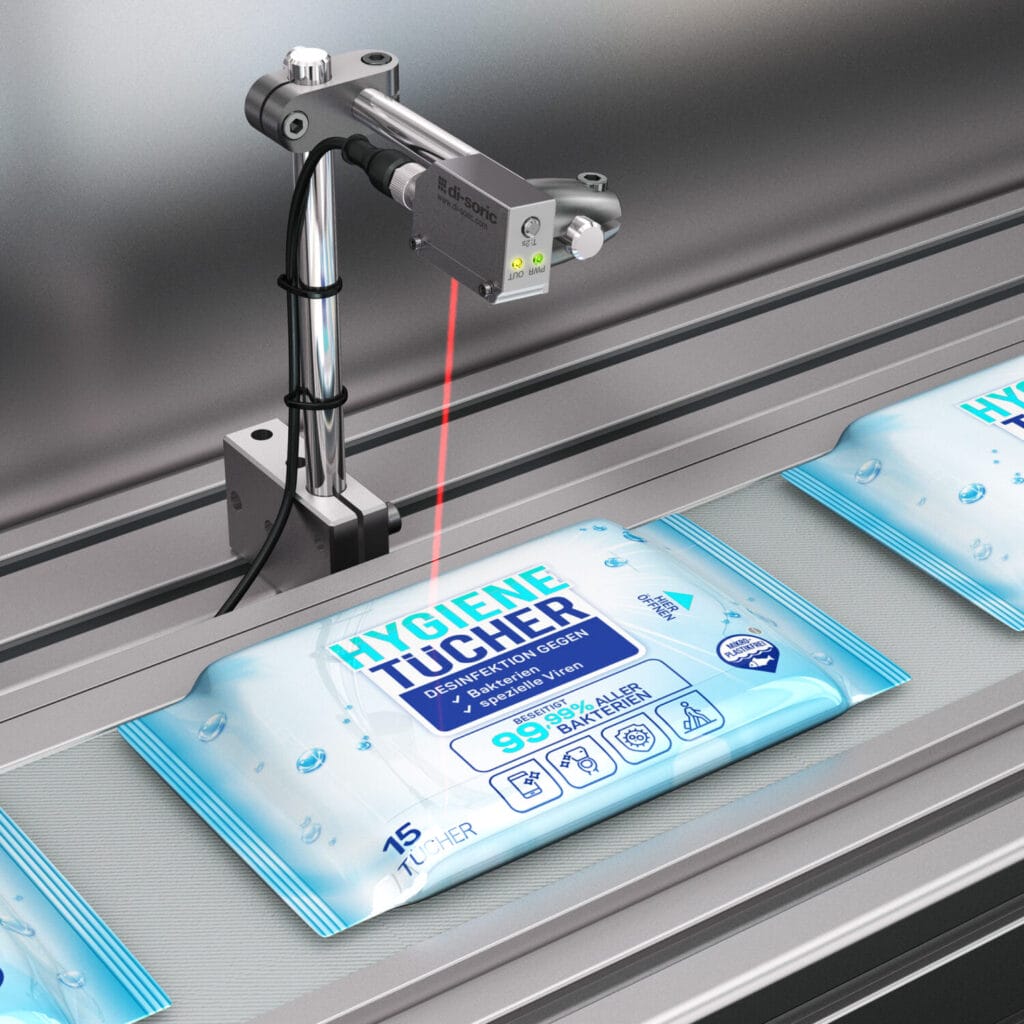
The DD mode is a special performance feature that simultaneously evaluates distance and intensity, thereby enabling reliable object detection. This function was previously reserved for larger sensors only and represents a significant advancement in sensor technology.
Extensive product range for individual requirements
di-soric offers a total of 36 device variants, enabling users to find the right sensor for almost any optically solvable task. The sensors are capable of covering long distances: Retro-reflective sensors from the OT33/OT34 series can bridge up to 1,000 mm with red LED light. Retro-reflective photoelectric sensors from the OR33 and OR34 series are used for distances up to 6,000 mm. Through-beam photoelectric sensors achieve reliably processable ranges of up to 15,000 mm. Whether using laser or LED light sources, the sensors are designed to meet specific customer requirements.
„The O-33 and O-34 series optical sensors are extremely high-performance and versatile in their application. Their long ranges and high functional reliability help mechanical engineering to make processes more efficient and significantly reduce downtime.“
Jürgen-Ralf Weber, Product Manager at di-soric
Robust construction for demanding environments
In industrial applications where mechanical stress is high or aggressive liquids are involved, the O-34 series sensors are used in a V4A stainless steel housing. These are Ecolab detergent resistant and offer IP69K protection. They are ideal for applications such as in fully automatic extrusion saws, where cleaning liquids are used.
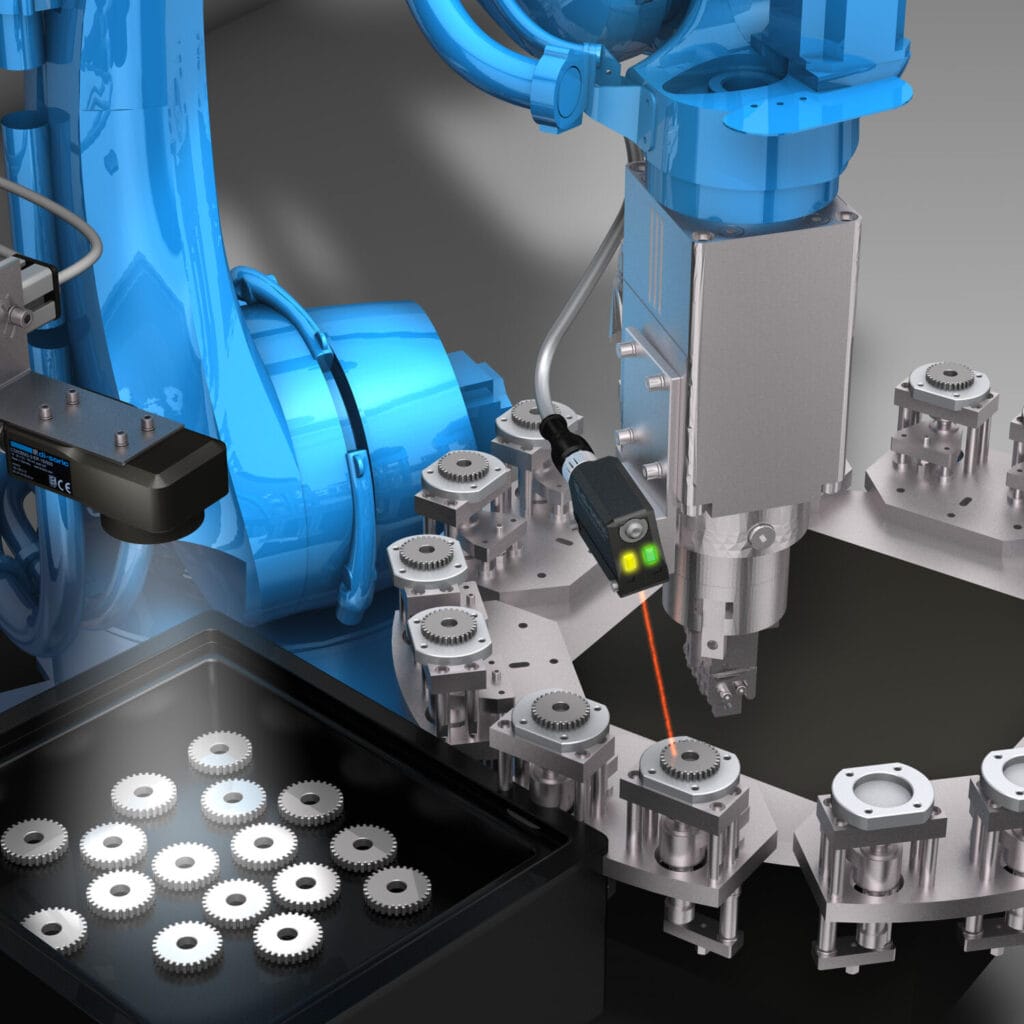
The sensors are not only robust but also extremely compact. With a housing size of just 30 × 20 × 11 mm and a hole spacing of 25.4 mm, they can be mounted flexibly and can reliably detect objects even from a greater distance.
Optimising processes with dual switching outputs
Another highlight of the new sensors is the ability to set two switching outputs per sensor with millimetre precision via the IO-Link interface. This function offers double the benefit, for example, when handling sheet metal in automated applications. The sensors can control the approach speed of robots, making the overall process more efficient.
All di-soric sensors are ready to go „out of the box“ and, with their factory settings, are already prepared for numerous applications. Users appreciate this, as Jürgen-Ralf Weber knows: „It is proven di-soric standard that our customers can quickly and easily learn distances, switching windows, and the DD mode directly on the sensor at the touch of a button and then put it into operation immediately.“ The DD mode, which simultaneously evaluates distance and intensity and recognises virtually all objects after teach against the learned background, is a performance feature that was previously exclusively reserved for larger sensors.
Source: di-soric