
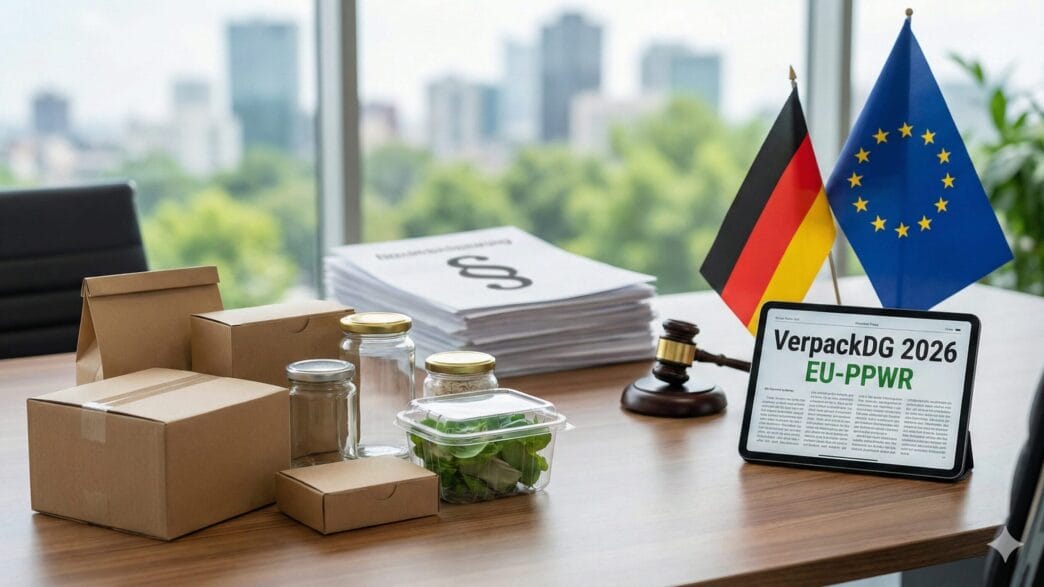
The new Packaging Act Implementation Act (VerpackDG) transposes the PPWR into German law – and brings significantly more bureaucracy for the industry than is required by European law. Packaging law expert Dr. Markus Pauly sees the law as a prime example of gold-plating and warns of distorted competition with other EU member states.
In February, the Federal Cabinet passed the draft Packaging Act Implementation Act (VerpackDG). The Act establishes the national legal framework for the implementation of the EU Packaging and Packaging Waste Regulation (PPWR) and will completely replace the existing Packaging Act from 12 August 2026. This step is generally undisputed: „The fact is that the VerpackDG is a necessary prerequisite for enforcing the PPWR, which comes into force on 12 August 2026, in Germany,“ clarifies Dr. Markus Pauly from the Cologne law firm Pauly Rechtsanwälte. Pauly is considered one of the most renowned specialists for packaging law in Germany. However, when looking at the specific details of the Act, the expert's agreement quickly ends.
The Packaging Act, as amended by the cabinet's decision, is a prime example of over-regulation, the opposite of bureaucracy reduction and ‚gold plating‘.
Dr. Markus Pauly of the Cologne law firm Pauly Rechtsanwälte
The Central Agency Packaging Register (ZSVR) will become a „super authority“, with new licensing procedures for Producer Responsibility Organisations (PROs) and new definitions being introduced. His conclusion: „In any case, the regulations go beyond the minimum requirements of the PPWR for national implementing acts.“

One of the most far-reaching innovations concerns the registration requirements. In future, all extended producer responsibility organisations and individual producers that do not use collective systems will require formal registration, which will be processed through the ZSVR. The legislator is relying on a high degree of automation for this. Pauly considers the extension to producers of packaging not subject to collective participation to be not absolutely necessary under European law: „A leaner solution would have been conceivable here, one that does not interfere so much with the functioning market for packaging disposal at B2B collection points.“ Producers of transport, reusable, industrial and commercial packaging would also be affected in future – an area that has so far been largely left out.
Redesign of the ZSVR financing
Linked to this is the redesign of the ZSVR (Central Register for Packaging) financing. Previously, the dual systems and operators of industry solutions primarily bore the costs of the register. In the future, individual manufacturers and producers of non-system-participating packaging will also be directly involved in financing – a significant expansion of the circle of those liable for costs.
Pauly is particularly critical of the choice of legislative model: „The approval procedure for Producer Responsibility Organisations (PROs) has already proven difficult with the Battery Law Implementation Act (BattDG) and has, in part, not commenced on time there. A bad precedent,“ says Pauly, „that should not be followed.“ For practical purposes, this means: If the approval procedure starts as sluggishly as with the Battery Law, companies could be left without legally secure disposal structures shortly before 12 August 2026.
Beyond the national implications, Pauly turns his attention to the European dimension of competition. The PPWR deliberately creates uniform framework conditions for all member states. However, with the VerpackDG, Germany is taking its own, stricter path: „In view of the uniformly European regulations of the PPWR, the content of the VerpackDG should have been coordinated with other member states. As things stand, Germany is once again engaging in typical ‚gold plating‘ to take on a pioneering role. Competitive distortions within Europe are thus predetermined by excessive regulations in Germany.“
Specific requirements
Setting aside the criticism of the regulations, the law imposes specific operational requirements on the entire packaging industry. From 1 January 2028, stricter recycling targets will apply: 95% of aluminium and ferrous metals must be recycled, whilst a new target of 75% applies to plastics, of which at least 70% must be recycled as material. Furthermore, the Packaging Act stipulates that dual systems and individual manufacturers must in future allocate a mandatory minimum proportion of their budget to waste prevention measures – earmarked for reusable and refill systems, start-up funding for circular business models, and consumer information on refill options.
Separate requirements apply to single-use plastic beverage bottles. PET bottles must already consist of at least 25% recycled material during the current transition phase; from 2030, a 30% recycled content requirement will apply to all plastic beverage bottles. Strict documentation requirements ensure that compliance can be verified by the authorities.
Time is running out for businesses. The cabinet's decision is merely the start of the national legislative process: after notification under European law, the Bundestag must deliberate and pass the draft, and the Bundesrat will be involved. The aim is to conclude by summer 2026 – shortly before it comes into force on 12 August. The draft bill estimates the compliance costs for the economy at around 2.46 million euros annually, as well as one-off implementation costs of approximately 4.46 million euros. Those who have not prepared for the new approval and reporting processes by then will be under pressure.