Fully automatic gluing of a wide variety of gimmicks onto magazines - the engineering firm Kock from Kiel was able to fulfil this wish of a northern German printing company with two Adept Quattro delta kinematics and the PackXpert software including image processing. Up to 5,500 glued magazines leave the system every hour.
Since the late 70s, when the comic book Yps The first time the magazine attracted attention on a large scale with enclosed children's toys such as small plastic compasses or the "Urzeitkrebs" rearing set, a wide variety of magazines resorted to such gimmicks. For many years, they were glued on by hand in a northern German print shop. Two skilled employees managed an average of 3,000 magazines per hour.
Ingenieurbüro Kock from Kiel, an experienced special machine manufacturer that has already successfully realised several projects with the printing company, took on the challenge of automating the gluing of a wide range of different gimmicks. For the ambitious target of 5,500 glued units per hour under special conditions, only one robot came into question for Kock: the Adept-Quattro.

This robot has patented kinematics that have been specially developed for high-speed packaging tasks and material handling. It is the only robot in the world with a 4-arm design that achieves extremely high speed and acceleration across the entire working range, even with higher payloads, making it the ideal machine for handling gimmicks.
Separation and feeding in the correct position
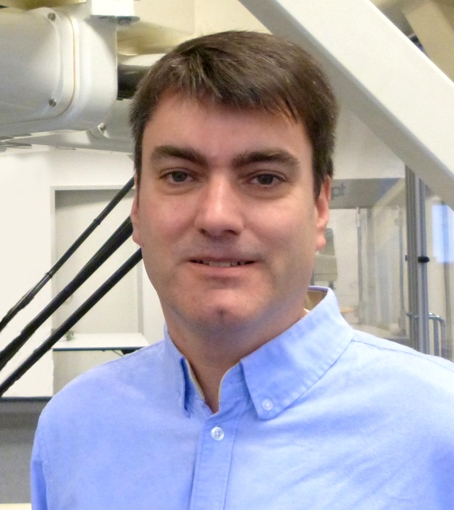
Peter Lange, head of Adept's application department, who supported Kock and his team on this project, remembers the initial contact well: "When we saw the many different types of toys, we had serious doubts. We were sure that our Quattros would be able to grip and apply the various gimmicks in the required cycle time, but only if the problem of separating and feeding them in the correct position could be solved."
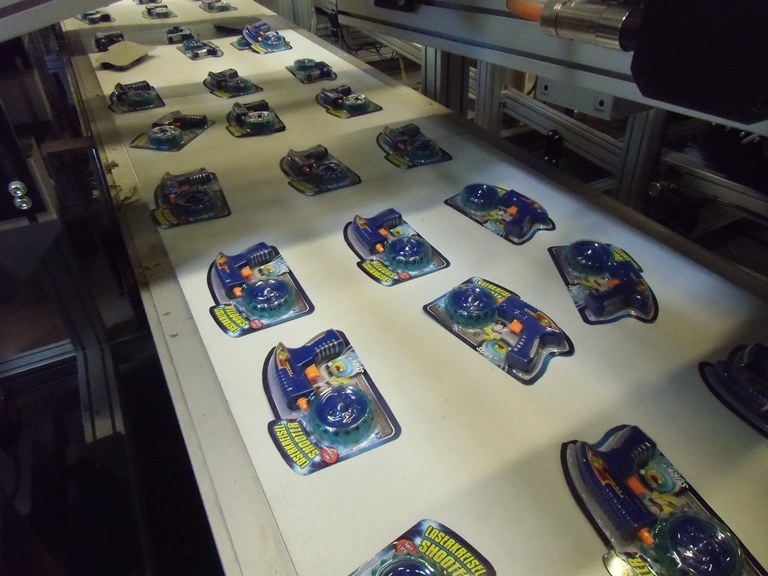
In fact, the engineering office already had the solution at hand, as Managing Director Kay-Olaf Kock emphasises: "We are familiar with the problem that products which, due to their size and flat shape, do not have self-separating properties and can be combined with conventional feeding systems cannot be separated. For these cases, we have developed a unique separation system that can be used to prepare loose three-dimensional products for further processing by robots." In this specific case, the gimmicks delivered in large cardboard boxes are poured into a hopper, portioned, separated, sufficiently organised and placed on a feed belt at a certain distance. This technically extremely complex solution has proven to be process-safe and absolutely reliable.
Product identification and speed
The feed belt then transports the gimmicks through a camera tunnel. The integrated image processing system identifies the product and determines the position of the gimmicks on the belt. The system also recognises which parts are in the correct position on the belt, i.e. with the sticky side facing downwards, and can therefore be picked up and stuck on by the robots. Incorrectly positioned parts with the adhesive side facing upwards remain on the belt, are automatically aligned in the correct position and fed back into the system.
An interesting detail is that the image processing system not only recognises the position and orientation of the individual gimmicks, but also provides information on how many correctly positioned parts it has detected. Based on this value, the control system automatically adjusts the speed of the feed belt so that exactly as many gimmicks are fed in as the robots can process.
Stick on in fly-by
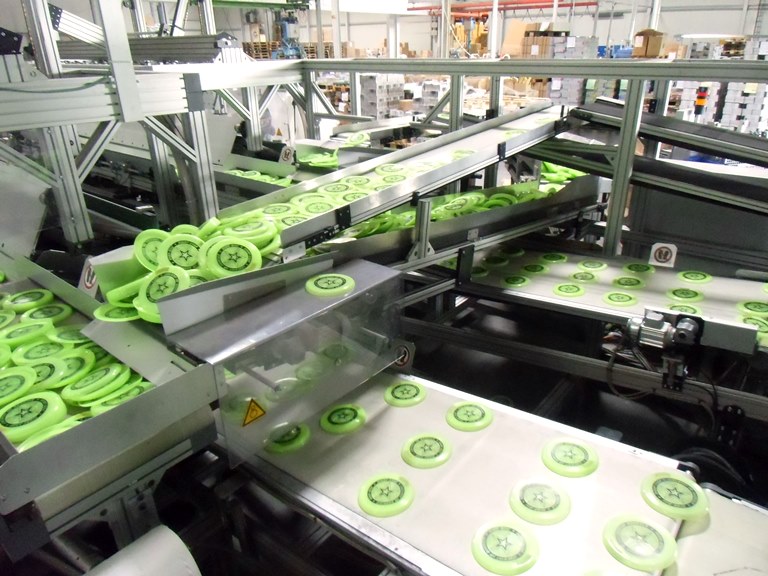
Two identical Adept-Quattro s650H robots are used to achieve the ambitious pick-and-place performance. Each robot has its own feed conveyor belt and constantly alternates between the magazines. As soon as one of the robots has picked up a gimmick from the feed belt with its vacuum suction cup, the software calculates the position and speed of the next magazine that the robot can reach. The delta robot then moves to the magazine conveyor belt below, travels briefly with the magazine in question and, once it has reached the defined position, places the item from a height of around three millimetres onto the spot marked with a small adhesive dot using a pulse of compressed air. The gimmick is therefore not pressed directly onto the magazine by the robot, but is applied without contact via a blowing pulse thanks to perfect synchronisation of the robot with the magazine conveyor belt.
To ensure that this works reliably with an average cycle time of 1.3 seconds per robot, Peter Lange and his team have optimised the process during the tests with a High-speed camera analysed in detail, as the individual sequences can no longer be made out with the naked eye. Based on these video analyses, the processes were then optimised until the desired placement performance was achieved, a service from Adept that system integrators are always happy to use.
Given the relatively large height difference between the feed belt and conveyor belt, many other delta robots would have had to fit. Not so the Adept Quattro s650H. Peter Lange: "The cylindrical working area of the Adept Quattro s650H with a diameter of 1,300 mm already covers a height of 215 mm. Below this, however, there is an additional conical work area with a height of 285 mm. This gives the Quattro s650H a stroke of 500 mm in the centre - more than enough for gluing magazines. The same applies to the load capacity of 6 kg."
User-friendly system concept
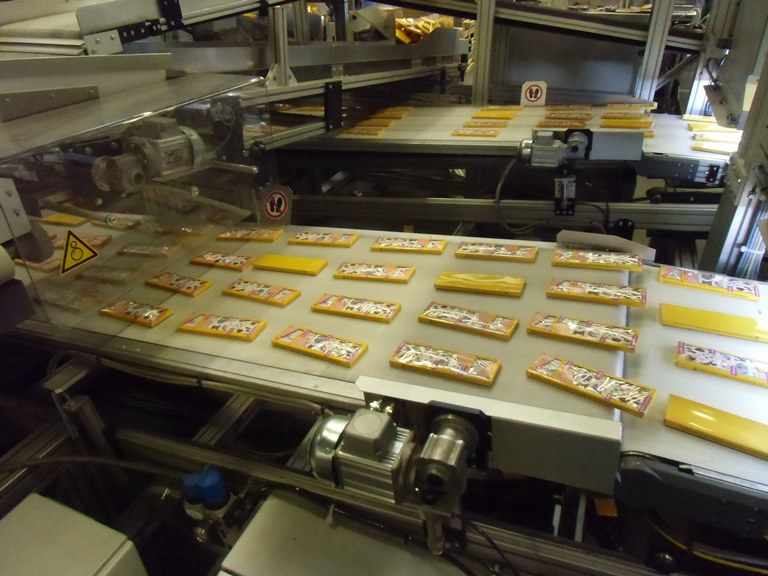
As the system has to be changed over frequently (as a rule, no gimmick runs for more than a day), Kock and Adept have focussed on simple changeover and teaching-in of new products. "The operators often have to teach in new products several times a day. This changes both the gimmicks and their positioning on the magazines. However, the system manufacturer Kock has succeeded in designing the system to be very user-friendly both mechanically and in terms of the control system. Teaching in a new product takes about fifteen minutes after a briefing and with a little experience," emphasises Peter Lange.
Adept has developed a simple programming and parameterisation system for complex high-speed packaging applications. Adept-ACE PackXpert software tool. Instead of traditional programming, the application-specific packaging tasks are parameterised via an intuitive graphical user interface. Regardless of whether one or more Adept robots are used, different cameras are used, the robots are used in band synchronisation or in cycle operation, the software tool has already integrated the complete functionality for almost every task. This reduces the time required between system design and commissioning to a minimum and increases the process reliability of the realised packaging solution.
Peter Lange was able to experience for himself how well this works in practice with the complex gluing system: "After the employee training and a few calls during the optimisation phase, I didn't hear from the operators for months. So, slightly worried, I picked up the phone. My concerns quickly turned out to be completely unfounded. I was told that the system worked quickly and to my complete satisfaction and that there were no problems with operation. A direct hit in terms of automation - what more could you want?"