Since 1986, Barsch GmbH & Co. KG from Reiskirchen has been developing modular horizontal flow pack machines. The company specialises in customised solutions for food, hygiene products, medical technology, pet food, and technical articles. Today, the specialists are working on technologies that could fundamentally change the market.
Barsch is considered one of the few companies in the field of horizontal flow-wrapping machines that develops its machines in a completely modular, digitally configurable, and consistently software-structured manner. They combine classic mechanical engineering expertise with a remarkable strength in digital configuration and agile product development. The latest example is the integration of an inline colour printing solution, which allows each individual package to be printed individually and in full colour during the process. What was previously considered a promise of the future in the industry is already a reality here.
Mechanical engineering with functional modules
Barsch's flow pack machines follow a clearly structured modular logic: eight functional modules make up the entire machine: from the product infeed and packaging material feed to format assemblies, longitudinal and transverse sealing, and product discharge.

Each of these modules is available in at least two variants, with a significantly larger selection available in some areas. In addition, users can choose from over 100 additional options, for example, for product handling, sealing technology, sensor technology, labelling, or integrated printing systems. The company's digital configurator maps all variants and dependencies using software. This allows machines to be assembled precisely according to product requirements – with no room for interpretation, clearly defined interfaces, and complete variant logic. For users, this means a high level of technical transparency.
With integrated inline colour printing, Barsch is adding a new technological feature to the packaging machine's capabilities – printing where packaging occurs. „For the first time, we've demonstrated that full-colour inline printing on flow-wrap paper is possible within the process,“ emphasises Frank Lindenstruth, Managing Director at Barsch, where he is responsible for the design department.
Inline colour printing in the packaging process
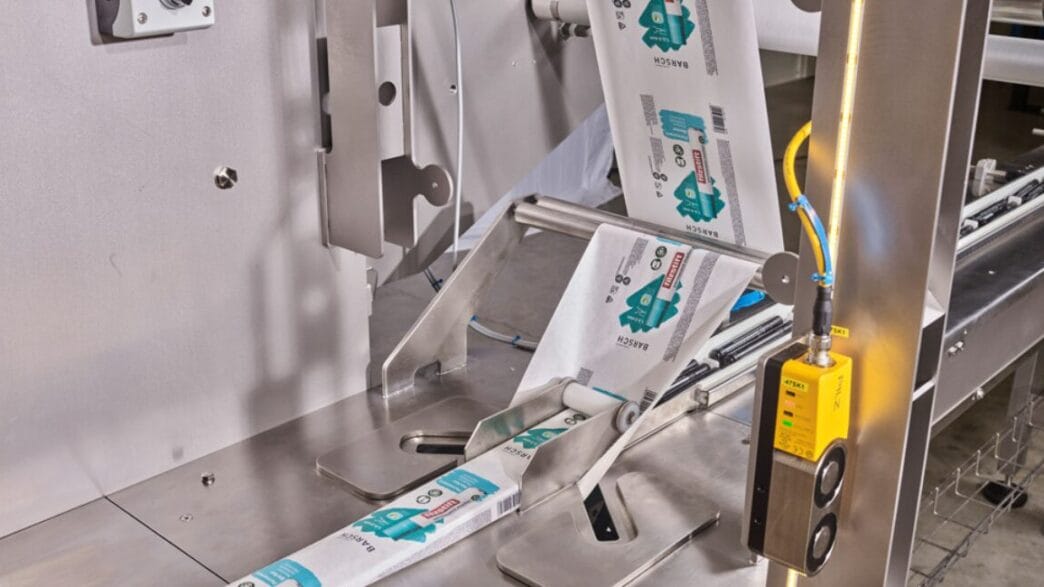
Barsch has integrated full-colour inline printing onto paper substrates directly into the flow-wrap machine: without external print preparation and without pre-printed material. This makes colour printing a fixed component of the packaging process. For the printing unit, the company works closely with the Dutch firm DJM. The result is a system that prints full-colour graphics, logos, photorealistic images, seasonal motifs, and variable data in real-time directly onto the paper during the flow-wrap process.
Several factors pave the way for a breakthrough: layout changes are digital within seconds, there are no minimum quantities, and even 50 pieces with a special design can be produced economically, eliminating the need for stock of films and waiting for the print service provider.
Alongside flexibility, cost-efficiency, and speed, sustainability aspects also favour this solution: significantly lower packaging weight compared to cardboard, deep-drawn, or blister packaging, as well as the use of mono-materials. Pre-printed film rolls and waste due to design errors are eliminated, and storage and logistics costs are significantly lower.
Furthermore, new business models such as limited editions, personalisation, and regional or daily promotions can be elegantly realised. Single-pack customisation becomes industrially possible.
Industrial inkjet colour printing demonstrates a new quality: colour motifs, textures, and variable content can be realised simply by changing the print job. The test speed is up to 20 metres per minute, and the system is designed for up to 90 metres per minute. By cascading multiple print heads, the print width can be extended to cover almost the entire paper web.
Tests at 600 dpi have already achieved clear contours and a high level of detail. The print head is precisely synchronised with web guiding, material transport and sealing process – no additional external systems are required.
„We see this as a new category: on-demand packaging. Each package can, in principle, be unique.“
Nadine Barsch, daughter of the founder and managing director at Barsch
New production model
The solution scores through efficiency in the supply chain, attention-grabbing power on the shelf, and the development of new product range concepts. This allows manufacturers to react to trends at very short notice.
The inline colour printing solution is particularly well-suited for several sectors. In the food segment, it allows for seasonal packaging for confectionery, regional editions for snacks, or personalised gift packaging. In the non-food sector, stationery, personal hygiene products, and cosmetics stand to benefit, for example, through influencer collaborations, limited editions, or store-specific designs. New opportunities are also opening up in the pet food and medical technology sectors, ranging from batch-specific labelling to multilingual packaging variants for different markets.
The combination of a paper flow wrap and inline colour printing creates a technically and ecologically impressive alternative. Up to 1,200 dpi are technically possible, allowing for graphics, logos, fine textures, and photorealistic product images. As each pack is printed on demand, there's no need for stock-keeping, transport costs, or the overproduction of pre-printed rolls.
Gamechanger for stationery
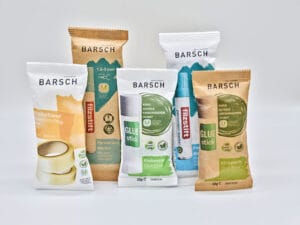
To demonstrate the potential of full-colour inline printing on paper, Barsch has implemented the packaging of three typical stationery products in flowpacks: felt-tip pens, glue sticks, and correction rollers. These products are sold in their millions at retail: but so far, almost exclusively in plastic blisters, which are neither sustainable nor flexible in terms of design.
A single paper material replaces both the plastic blister pack and labels and additional cardboard packaging. The variety of articles can be mapped without logistical complexity. Instead of 20 to 30 pre-manufactured packaging materials per series, only one neutral paper is needed for production, the rest is created digitally.
A classic problem with paper packaging: the product cannot be seen. Full-colour inline printing allows the product to be printed photorealistically directly onto the paper surface. Without plastic, the product is visible from the outside, protected on the inside, and the packaging is made entirely of paper.
Potential as a trendsetter
The packaging industry is driven by three major themes: sustainability and the PPWR, individualisation of trade, and digitalisation. Paper and mono-materials are set to replace complex composite materials: inline printing makes this transition more economical. Smaller batches, seasonal concepts, and short-term design adjustments become possible without printing presses and setup times. Each package can be individually printed at the moment of production: variety, market, language, and promotion are freely combinable. Packaging becomes both an information carrier and a marketing tool.
This creates an approach that is not only technically interesting but also enables new business models in trade and industry.