According to the Group, it will reduce emissions from its own production and purchased energy by around 30 per cent by 2030. Emissions from the use of products are to be reduced by 16 per cent by 2030. thyssenkrupp's new climate strategy is based on the Paris Climate Agreement of 2015.
„The threats posed by climate change concern us all. As a globally active industrial company, we have a particularly large amount of leverage to sustainably reduce greenhouse gas emissions with resource-saving products and processes. We take this responsibility very seriously. We have received several awards for this in recent years. We are now setting ourselves clear targets for 2030 and 2050, which is the next logical step.“
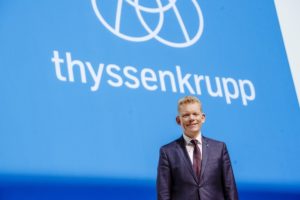
Guido Kerkhoff, thyssenkrupp CEO
In February, the non-governmental organisation CDP named thyssenkrupp one of the best companies worldwide in climate protection for the third time in a row, assessing whether companies formulate a coherent strategy on how they can further improve their own carbon footprint as well as that of their customers and suppliers. thyssenkrupp was once again awarded the highest score and placed on the global „A List“. The list comprises around 130 companies worldwide and only five DAX companies.
Two approaches to reducing CO2 emissions
The targets now announced cover the Group's own production, purchased energy and thyssenkrupp's products. In steel production, for example, thyssenkrupp is currently pursuing two approaches to reduce CO2 emissions: On the one hand, the Carbon2Chem project, which is expected to be available on an industrial scale before 2030.

In addition, there is the so-called hydrogen route, which should be fully effective by 2050 and make the greatest contribution to the direct avoidance of CO2. Carbon2Chem converts the steel mill emissions known as metallurgical gases into valuable chemicals, including the CO2 they contain.
With the hydrogen route, thyssenkrupp is focussing on the long-term use of „green“ hydrogen instead of coal as a reducing agent, so that no CO2 is produced during steel production in the first place. The technologies are subsidised by the federal government and the state of North Rhine-Westphalia. As part of the Climate Action Programme for Sustainable Solutions (CAPS), thyssenkrupp will also systematically develop its product range in the direction of greenhouse gas neutrality.
Innovative technologies and sustainable mobility
The Group already offers the cement industry a technology that can be used to capture CO2 emissions from combustion processes so that they can then be stored or further processed.
In the area of sustainable mobility, the Group is working with European partners on the production of fuels from biomass. These fuels reduce CO2 emissions by up to 90 per cent compared to conventional fuels. Further focal points: Expansion of the electromobility sector with production facilities for battery manufacturing or special materials for electric motors.
Development of energy storage systems
In addition, the Group is already active in the development of energy storage systems, for example with electrolysis plants for converting electricity into hydrogen. This storage solution allows renewable energies, where the supply fluctuates depending on the weather, to be used continuously. t
„Our targets are ambitious, but achievable. With our strategy for steel alone, we can reduce our production-related emissions there by 80 per cent by 2050. However, in order to achieve the climate targets, we need significantly more renewable energies. There is also a lack of internationally harmonised financial incentives for investments in CO2 avoidance technologies. These are basic prerequisites for really making a difference.“
Dr Donatus Kaufmann, thyssenkrupp Executive Board
Source: thyssenkrupp