Detergent manufacturer Werner & Mertz and its cooperation partner Alpla have succeeded in increasing the proportion of recyclate from the Yellow Bag for PET bottles to 50 per cent.
The Mainz-based manufacturer of detergents, care and cleaning products is now increasing the proportion of rPET in its bottles to 50 per cent from the Yellow Bag. The first 200,000 bottles for the Frosch brand are already being from March 2021 for use. All PET bottles will be converted to the new format by the end of the year.
Advanced mechanical recycling thanks to a fully automated system
As early as 2012 Werner & Mertz Together with Alpla and other co-operation partners along the entire value chain, the Recyclate initiative and since then has been committed to ensuring that recyclable materials are reprocessed and reused to a high standard after use and thus remain in the cycle.

In 2014, for example, the PET bottles of the well-known Frosch brand to switch to 100 per cent PCR (post-consumer recyclate), 20 per cent of which comes from the Yellow Bag source. The remaining 80 per cent comes from the European beverage bottle collection (bottle to bottle). Over 440 million of these bottles have been sold to date.
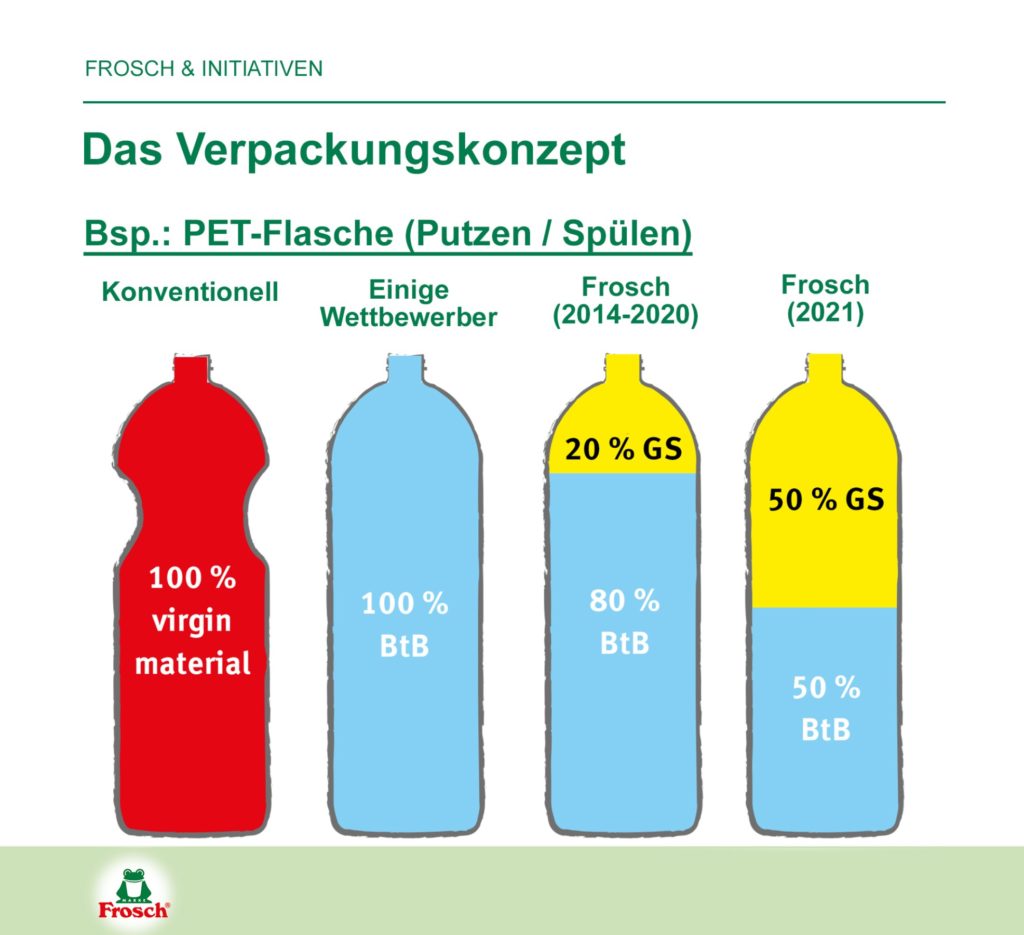
Werner & Mertz has long sought to increase the proportion of rPET from the Yellow Bag. Until now, the existing technology has not allowed the desired transparency to be achieved with rPET. A decisive step forward has now been taken: PET Recycling Team Wolfen has been active since October 2020. Into the one from Alpla The joint venture established with Fromm involved an investment of more than eight million euros.
Almost everything at the new recycling plant is fully automated: The PET delivered comes from yellow bags or bins exclusively from German plastic collection systems and plastic processors and is pre-sorted in so-called lightweight packaging systems.
This is followed by an exact separation into transparent PET and coloured PET. The high-quality Fine sorting is a further development of the familiar infrared technology (NIR). In the next step, Texplast Wolfen turns it into transparent granulate, which Alpla then processes into preforms and bottles.
In this way, recyclable materials from Germany are recycled in Germany and reprocessed into bottles for internationally active companies. A Completely national solution, which also minimises transport distances.
„Werner & Mertz is not only a long-standing and valued customer for us, but also a driving force for the entire industry. We hope that this example will motivate other companies to use these high-quality recyclates. Everyone is talking about sustainable packaging, together we are proving that it works,“ says Georg Lässer, Head of Corporate Recycling at Alpla Group.
Reinhard Schneider, owner of Werner & Mertz, emphasises that the new bottles do not differ in look and feel from the previous packaging: „The customer will not notice any difference in quality. We are deliberately not revealing which format we will change to first - we did the same when we switched to 20 per cent Yellow Bag to test the reactions. The result: none at all. Nobody noticed. For us, this is the best proof that Real sustainability is also possible without sacrifices or half-hearted compromises is.“
Calls for legal incentives for the use of PCR
The example shows: High-quality sorting technologies are available and the quality of the recyclate is high. But why is Werner & Mertz still as good as it is alone in the use of recyclate from the Yellow Bag?
Reinhard Schneider: „The higher costs of recyclate compared to virgin plastic continue to deter many manufacturers, This problem has been exacerbated by falling crude oil prices. But if the high recyclate qualities are not in demand, there is no basis for investing in better sorting and processing, as Alpla has just done on a large scale. Recycling becomes more economical the more people join in. An enormous opportunity.“
Werner & Mertz therefore demands that the legislator Financial incentives for the use of PCR to effectively counteract the littering of our planet and achieve a climate-friendly plastic cycle. The company is in favour of creating a fund into which all distributors must pay and only those who use Post Consumer Recyclat will receive a refund.
Alpla invests 50 million euros annually in recycling activities
The Alpla Group has now announced that it will invest an average of 50 million euros annually in the further expansion of its recycling activities until 2025. The main plan is to internationalise measures for high-quality recyclates in order to close material cycles in as many regions as possible.
„We have been very active over the past two years. We have been able to launch bottle-to-bottle projects in Asia, Europe and Central America, among others. Nevertheless, we continue to see growing demand from our customers worldwide,“ says Georg Lässer. This unbroken demand gives Alpla the opportunity to initiate further investment projects.

Georg Lässer sees long-term development opportunities in countries outside Europe: „Customers all over the world ask us for packaging with a recycled content, now also in Africa, the Middle East, South East Asia, China and India.“ Regarding Europe, the expert says: „This market is now highly competitive. Thanks to our own plants and co-operations, we achieved a good market position in Western Europe early on, which we want to expand.“
The entry into HDPE recycling in 2019 was a milestone for Alpla. This will continue with the construction of a plant in Toluca (Mexico), with production scheduled to start in autumn 2021. The company is also currently building a recycling plant for PET and HDPE in Thailand with a cooperation partner. Capacities at existing plants in Austria, Poland and Germany have been expanded over the past two years, including the installation of an rPET extrusion line at the company's own preform plant in Italy.
Sources: Werner & Mertz and Alpla Group