Pharmaceutical production is about to take the next step in its development: with the help of digital tools, manufacturers can already reduce downtime, increase productivity and improve flexibility. The next step on this path is the intelligent networking of people, data and technology. Two factors are crucial: knowledge and machines.
How do the manufacturers of pharmaceutical filling and packaging systems to these new requirements of their customers? We asked the southern German mechanical engineering company Bausch+Ströbel enquired.
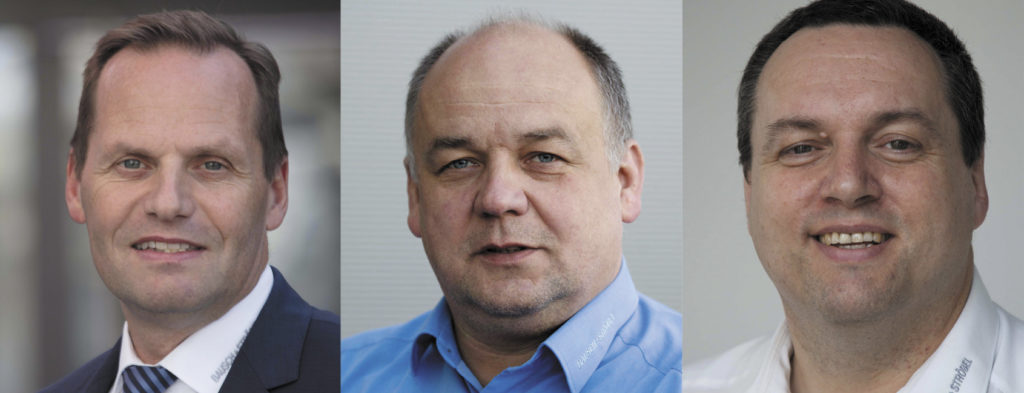
pj: At the Hannover Messe 2017, your company, as a partner of Siemens, already presented the possibilities of a digital twin presented. This year, as part of the Excellence United strategic alliance, its developers set new standards at this year's Achema with the joint Industry 4.0 concept. So digitalisation is a high priority at Bausch+Ströbel?

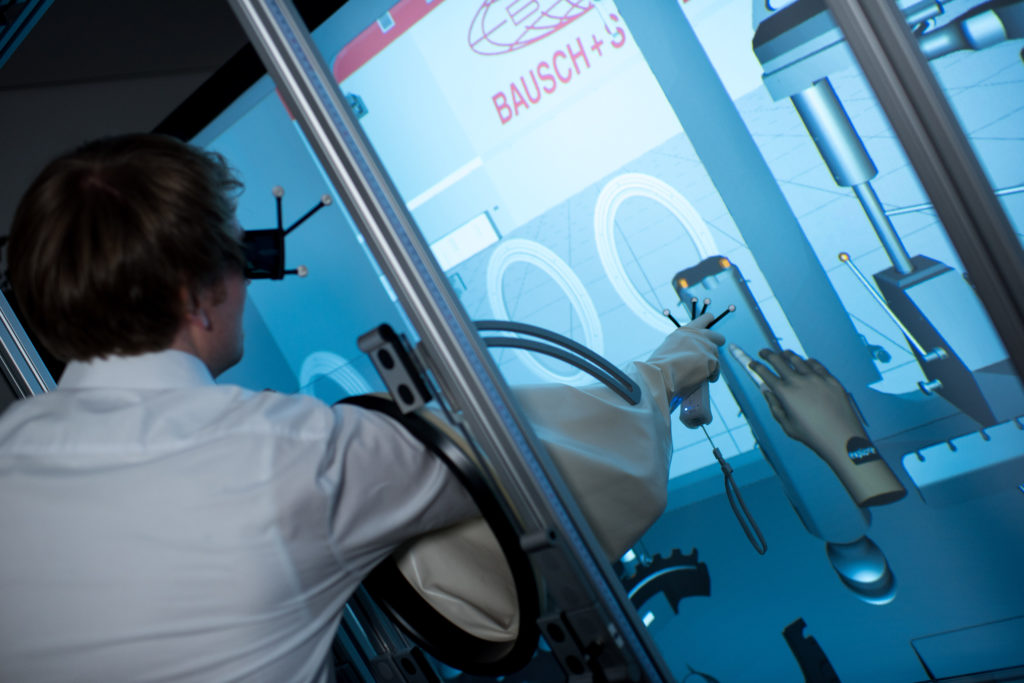
Dr Hagen Gehringer: That is correct. We have long since ceased to see ourselves purely as a manufacturer of filling and packaging systems and now offer our customers in the pharmaceutical industry comprehensive solution concepts. Digital tools have been part of this for years. One example of this is our Virtual Reality Centre to name a few. At a time when other companies in our industry were still mainly using virtual reality for marketing purposes, we were already working on making this technology usable for our customers.
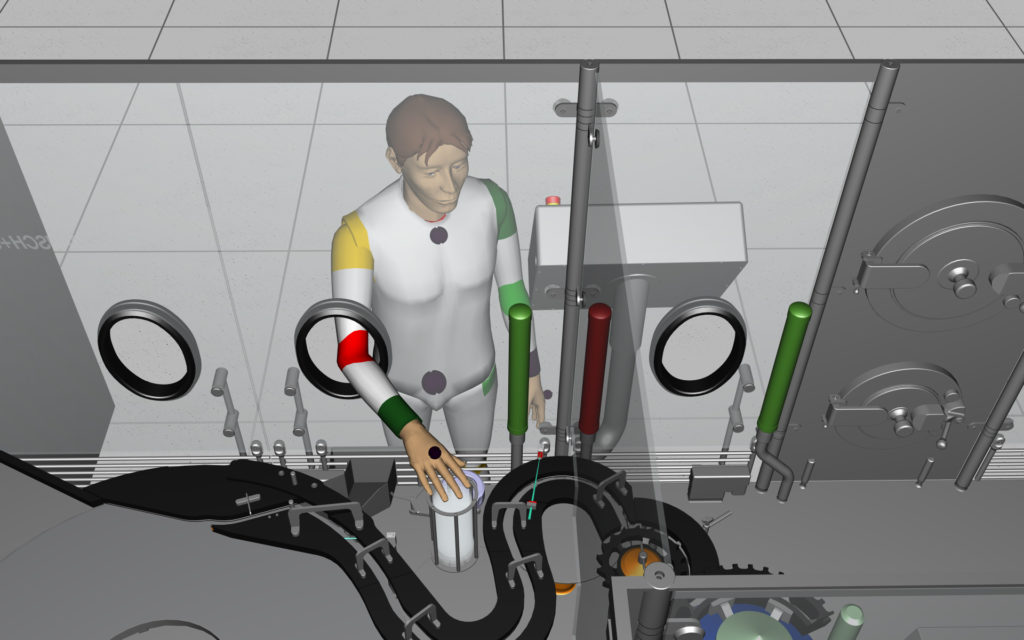
Virtual reality (VR) is now being used in entire Production cycle of our systems: from the initial presentation of possible solutions to more specific project planning and the design review through to the training of our customers' operating personnel and, ultimately, the planning of system modifications. Even flow simulations (CFD) can be carried out here at an early stage of the project.
pj: How does the digital twin fit in?
Dr Hagen Gehringer: Of course, movements can also be simulated in our VR Centre. However, unlike our VR Centre, the focus of the digital twin is not on the design of the machine, but on the Programming. It is a virtual model on which the programming of the system can be tested in concrete terms - even before it is actually built. A high percentage of this already works today. Only a few programme parts still need to be tested on the real machine. By 2020, we want to create the complete programming with the help of the digital twin - an enormous time saving for us and ultimately for our customers.
pj: Bausch+Ströbel is tackling the topic of Industry 4.0 together with its strategic partners from Excellence United. Is the topic too extensive for one company?
Dr Hagen Gehringer: Of course, we would have started this project on our own - but it is precisely for future projects of this kind that a Partnership It makes sense to join forces and benefit from each other's experience. Together with our partners (all of whom are also medium-sized family businesses and leaders in their respective fields), we have a total of around 50,000 systems on the market. Together, we have a wealth of experience in the field of pharmaceutical production.
[infotext icon]
In the strategic alliance Excellence United the five family-run companies Bausch+Ströbel, Fette Compacting, Glatt, Harro Höfliger and Uhlmann pool their expertise and offer their customers technologically leading solutions for the entire value chain of medical device and pharmaceutical production.
[/infotext]
This is also the advantage of our approach: our Jointly developed platform is not a solution that has simply been adopted from other industries, but has been designed from the ground up for pharmaceutical applications. This is the result of a two-year development process, which will of course continue.
pj: What exactly was developed and exhibited at Achema? There were long queues of visitors in front of the Cube.
Erich Bauer: With well over 400 visitors, the turnout was indeed very large. This also showed us how great the interest of our customers from the pharmaceutical industry is in this topic. On display in the Cube was our jointly developed IoT hub: an open and modular platform for software development and system integration.
Here, our users can network Excellence United systems as well as integrate systems from other suppliers. We have clearly demonstrated this in the Cube using a production line. The user benefits from a central interface via which they can continuously record machine and process parameters and make them available worldwide (both via a cloud and via the company network). Thanks to the open architecture and the modular structure the IoT hub is scalable. Users can utilise the platform economically for both individual machines and larger systems and expand it with new interfaces and apps that are developed individually or together with the customer.
pj: What will the next steps be?
Erich Bauer: The Excellence United digitalisation team - in collaboration with users - will now continue to expand the platform with the aim of further increasing the efficiency of systems and processes. A major topic here will be, for example „Predictive maintenance“ be the predictive maintenance of systems. The large amount of data supplied during the production process can be used, for example, to identify components that need to be replaced promptly.
Michael Pratz: Preparing this large amount of data for the user in such a way that he or she has a clear benefit is the basis for a large number of Possible applications. We demonstrated some of these at Achema and recently at FachPack in Nuremberg using the ESA 1025 labeller. AR (augmented reality), MR (mixed reality) and wearables (portable devices) visualise data directly on the system and open up previously unimagined possibilities for the labelling industry. Contextualisation of this data available. The use cases range from supporting maintenance technicians in troubleshooting to process training without having the system physically available. Using implemented trainer/trainee technologies, entire teams can work together virtually on the various training programmes. Application scenarios train and increase important GMP aspects in addition to a shorter operating time.
Dr Hagen Gehringer: In the coming years, we will create numerous possible applications - including some that we are not even thinking about today due to a lack of technical possibilities. The process remains exciting.