
Greiner introduces thermoformed IML cup

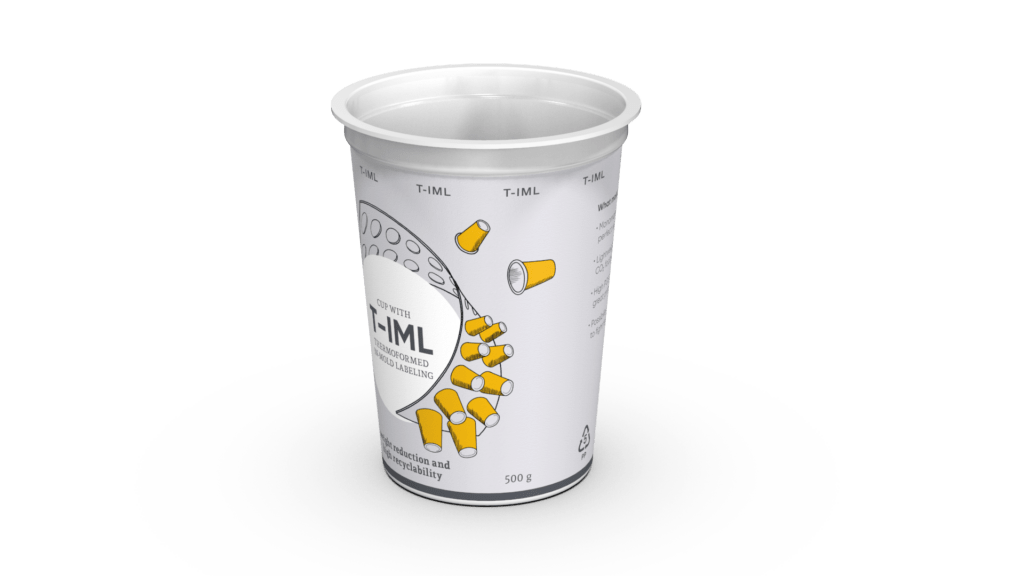
The Austrian packaging company Greiner Packaging presents a thermoformed cup that is already labelled in the mould using IML. Compared to injection moulding, the weight is reduced by 25 percent.

The Austrian packaging company Greiner Packaging presents a thermoformed cup that is already labelled in the mould using IML. Compared to injection moulding, the weight is reduced by 25 percent.

While in-mould labelling (IML) was previously only used in combination with injection moulding production technology, the Greiner Packaging is now expanding its expertise in the field of thermoforming by offering thermoformed IML cups. Less plastic is needed for thermoformed cups, which saves resources and makes the cups lighter. This means they produce less CO2 during transport. Both cups and IML labels are made of polypropylene (PP).

Moulding and decorating in one step

With in-mould labelling, a label is inserted into the thermoforming mould in which the product is formed and thus forms a permanent bond with the finished product. With this decoration method, moulding and decorating are carried out efficiently in just one step. Greiner Packaging is already able to produce T-IML cups: It has invested in a test tool and can offer cups with a diameter of 95 millimetres and 500 millilitres. By switching from injection moulding to thermoforming, the cup weight for this format is reduced from 15 to 11.4 grams - This corresponds to a reduction of 25 per cent.

(Image: Greiner Packaging)

„At Greiner Packaging, we are committed to a circular economy and want to be broadly positioned. Our new T-IML cups use less material and can be optimally recycled. This approach is exactly what we wanted,“ says Philipp Maurer, Key Account Manager at Greiner Packaging.

Display

Source: Greiner Packaging

Further news from the plastics and composites sector

Folding boxes with mountable feet

The Walther Faltbox Group is exhibiting foldable boxes with attachable feet at LogiMAT for more efficient handling of heavy goods in intralogistics. This development facilitates transport and storage, offering additional flexibility.
Read more "