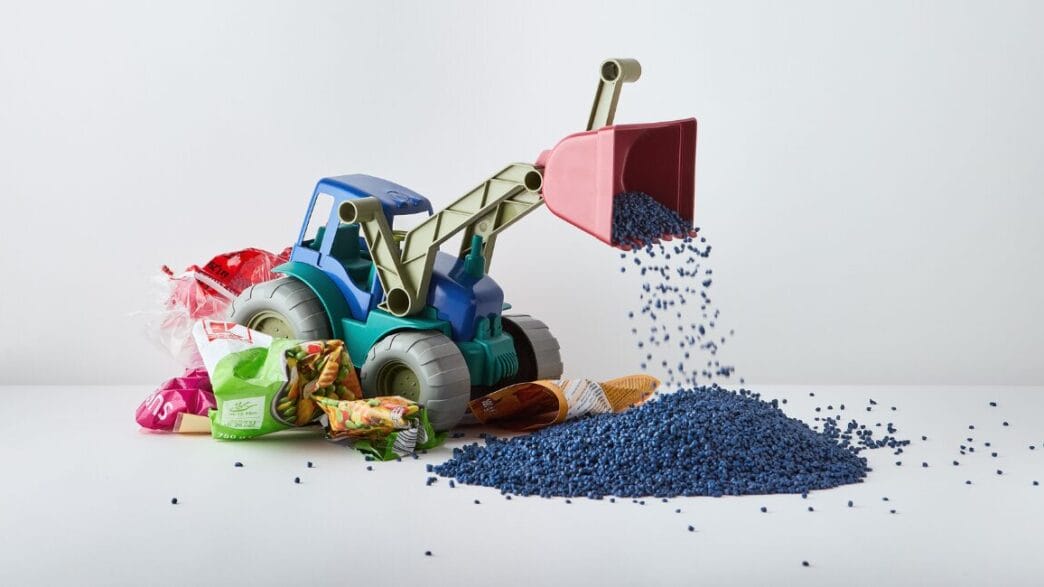
The Schwarz Group will successfully conclude its plastics strategy at the end of the 2025 financial year, which is also the target year for REset Plastic. As a follow-up strategy until 2030, the company is pursuing more comprehensive and ambitious packaging goals with its holistic circular economy strategy REset Resources.
By the end of the 2025 financial year, the Schwarz Group not only achieved its self-imposed targets but even surpassed them. In particular, the targets for reducing plastic and increasing the use of recyclates were significantly exceeded. The strategy comprised five fields of action: avoidance, design, recycling, disposal and innovation & education. This comprehensive approach enabled the company to establish a holistic circular economy.
Focus on recyclability
Significant percentage increases were achieved last financial year in the use of recycled materials and recyclability. For example, the target of reducing the use of plastic in own-brand primary packaging and transport aids by 30 percent compared to the base year 2017 was clearly exceeded with a reduction of 36 percent.

Even with the use of recyclates, the Schwarz Group companies met their target with an increase of six percentage points compared to the previous financial year. The retail divisions Lidl and Kaufland now use 26 per cent recyclate in their own-brand plastic packaging.
In the past financial year, Lidl and Kaufland were able to increase the proportion of their own-brand packaging made of plastic that is recyclable by a further four percentage points to 67 percent. As things stand, the maximum possible recyclability has been achieved, balancing product protection, material usage, and the use of recycled materials. This is currently limited by industry-wide and regulatory hurdles. Among other things, the specific European measurement methodology for the pending Packaging and Packaging Waste Regulation (PPWR) has not yet been finalised. Therefore, the comparatively strict German minimum standard is still being used as the benchmark for calculation. The companies of the Schwarz Group are transparent about these challenges and continue to pursue the ambition of making all own-brand packaging recyclable.
Future prospects
By developing the collaboratively created, holistic circular economy strategy REset Resources, the Schwarz Gruppe companies intend to further expand their pioneering role in the circular economy. Together, they are committed to five fields of action and the associated packaging targets, which for the first time include all types and materials of packaging. With the substantive further development of REset Plastic into REset Resources, they are optimising all material flows and the entire product life cycle. New, reformulated objectives here address all three REset Plastic fields – reduction (field of action REduce), use of recyclates (field of action REcycle) and recyclability (field of action REdesign).
With all the measures located under REset Resources, the divisions Lidl, Kaufland, PreZero, Schwarz Produktion, and Schwarz Digits aim to become more independent of global supply bottlenecks together.
Source: Schwarz Corporate Solutions