Mobile transport robots – when does autonomous navigation make sense?
The distinction between AMR and AGV is irrelevant due to a lack of technological differences, says intralogistics expert Safelog.
Mobile transport robots are becoming increasingly popular in intralogistics. But anyone who wants to automate their intralogistics processes is faced with a choice: autonomous mobile robot (AMR) or automated guided vehicle (AGV)? However, the distinction between AMR and AGV is irrelevant due to a lack of technological differences and a high degree of autonomy often does not make sense at all, says intralogistics expert Safelog.
For some years now, numerous suppliers of so-called autonomous mobile robots have been sprouting from the ground. They all share the promise of being able to automate intralogistical processes quickly and easily through autonomous robot navigation. The term „AMR“ for autonomous mobile robot is often used to distinguish it from the established driverless transport system. There is no technological justification for this distinction. Whether in drive, battery, control or safety technology – the hardware of the robots is almost identical. The often cited superior sensor technology, such as 3-D cameras for recording the environment, can be used with almost all mobile robots if necessary. Even in terms of navigation, the similarities are great. For example, many modern AGVs have the ability to navigate freely. It therefore makes no sense to differentiate between AMR and AGVs. Both are mobile transport robots (MTRs) that take on specific transport tasks and, depending on the application, may or may not have to perform certain autonomous functions.
Autonomy only makes sense in niche applications
AMR is often used to describe mobile robots that have a high degree of autonomy, can move freely in space, adapt their respective routes to the current spatial conditions and avoid obstacles independently – or because the manufacturer simply calls them that for marketing reasons. However, this often results in problems. Especially in production environments where high temporal precision is required due to a just-in-time cycle, autonomous navigation and the resulting unpredictable driving behaviour of the robots endanger process reliability.
This is because an evasive movement causes a time delay or represents an obstruction to other process participants. If there are other (manual) vehicles on the shop floor or complex traffic rules to be observed, it is difficult to ensure a plannable workflow with autonomous systems. If, on the other hand, a robot navigates a defined route with little autonomy, it completes its tasks efficiently, safely and reliably, which is a decisive advantage when many transport robots have to interact with each other, but also with other vehicles or peripheral systems.
Anzeige
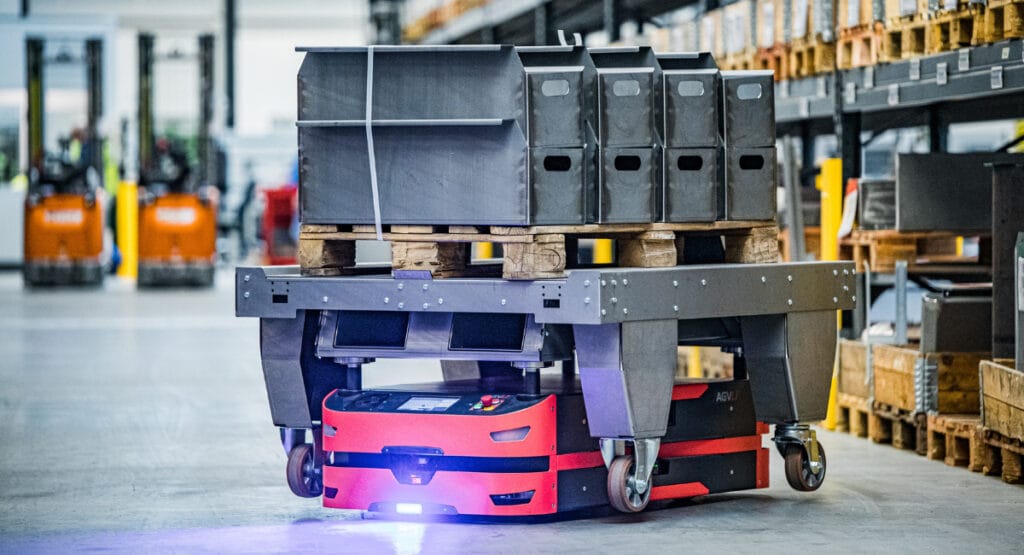
Especially in production environments with just-in-time clocking, a low degree of autonomy ensures high process reliability. (Image: Knoll Maschinenbau)
The situation is different in applications where delivery time and sequence play only a subordinate or no role. A high degree of autonomy also makes sense when interaction or even collaboration with employees is required. In a picking warehouse, for example, it can be advantageous if the robot avoids other vehicles in mixed traffic or has to react to many employees on the floor.
Robots communicate decentrally with each other in a swarm
Ultimately, the success of a project is not determined by the degree of autonomy, but by cost efficiency and stable, high technical availability. In particular, the company’s personnel are able to get the system up and running again in the event of a malfunction. The following applies: the less technology is built into a robot, the fewer potential sources of error and technological dependencies there are. This makes the system very robust.
Another sticking point is that the systems usually require a control centre to control the robots. This is cost-intensive to purchase, program and maintain and is not economical, especially for smaller automation projects with only a few robots. In addition, if the control centre malfunctions, the entire fleet breaks down. Modern mobile transport robots therefore have agent-based control. The robots communicate decentrally with each other in a swarm, inform each other of their position and speed and exchange information about disruptions on the route. Route planning and releases for route sections are also based on communication within the swarm.
The agent-based control enables efficient operation of a few robots up to several hundred vehicles without incurring higher costs as the number of robots increases. This makes it possible to implement profitable automation for small companies even with a low number of robots. Decentralised control not only increases efficiency but also process reliability. In the event of a malfunction, only the affected vehicle comes to a standstill, while the swarm continues to perform its tasks. The cost-intensive standstill of entire fleets, as with the control centre approach, is thus ruled out. The technical availability of the solution can reach a value of more than 99 percent.
With the swarm approach, only the affected robot fails in the event of a malfunction, while the swarm continues to perform its tasks. (Image: Safelog)
Conclusion
The distinction between AMR and AGV is irrelevant. Both terms describe mobile transport robots with more or less autonomous functions. Whether autonomous navigation makes sense depends on the respective application. Decisive for the success of automation with transport robots are the stability of the system, the cost efficiency and the availability of the fleet. Agent-based robots have a clear advantage here.
Packaging for decorative cosmetics is very special. The Forum Rezyklat calls for the recyclability of packaging to be taken into account when designing it.